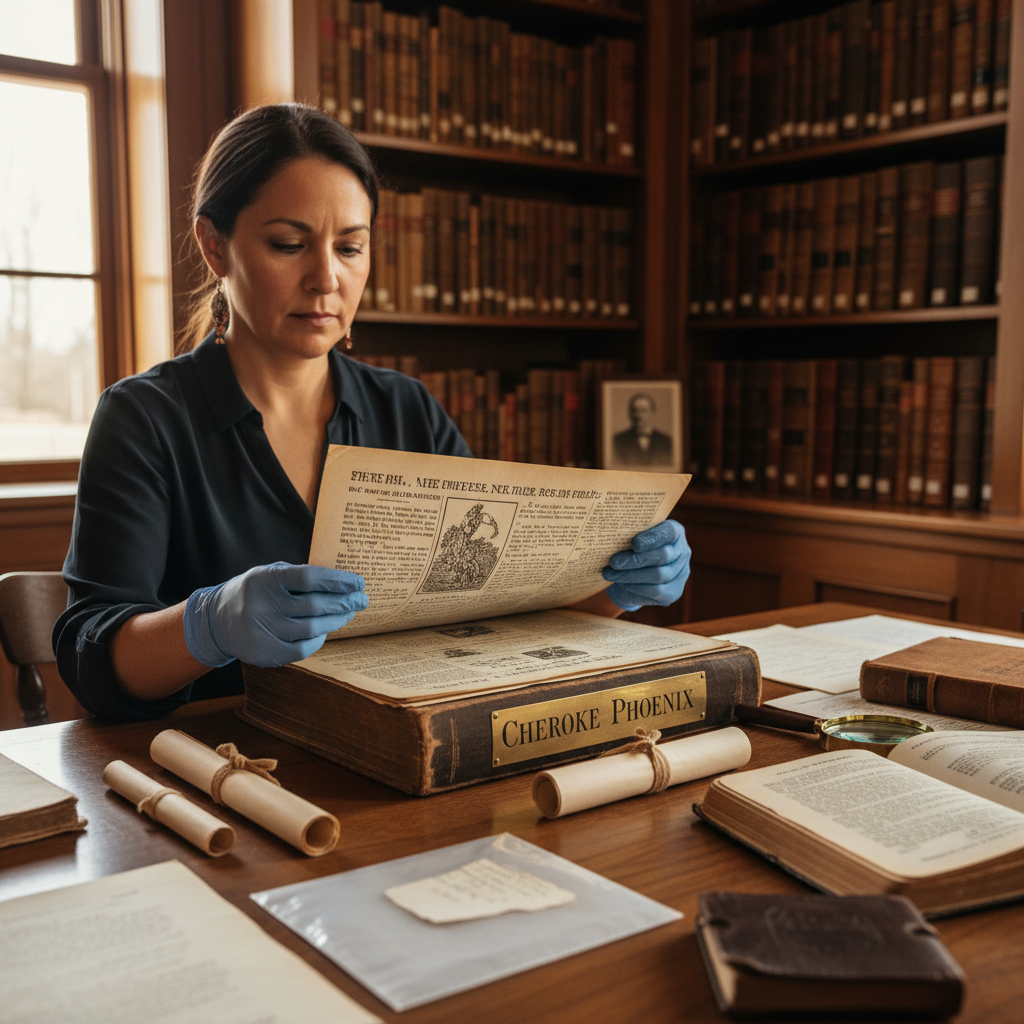
The Cherokee Phoenix: Journalism as an Act of Sovereignty
Let’s get one thing straight: the Cherokee Phoenix wasn’t just a community newsletter for local gossip or bake sale announcements. When the first issue rolled off the press in New Echota on February 21, 1828, it was a high-stakes political weapon. It was a declaration of intellectual independence and a sophisticated middle finger to a federal government that was already sharpening its knives for the Trail of Tears.
For those diving into Cherokee history through our stories, understanding the Phoenix is non-negotiable. It represents the moment the Cherokee people weaponized the very tools of “civilization”—literacy, law, and the printing press—to defend their ancestral lands. It was the world’s first Native American newspaper, and its legacy continues to shape the identity of the three federally recognized Cherokee tribes today.
Note: Osiyo.net is an independent information platform and is not an official tribal government site. This article provides historical context and should not be used for official enrollment or legal purposes.
The Invention That Changed Everything: Sequoyah’s Syllabary
Before we can talk about the newspaper, we have to talk about the man who made it possible. Sequoyah (George Gist) wasn’t a scholar or a linguist in the Western sense. He was a silversmith who realized that the “talking leaves” used by white settlers gave them a massive tactical advantage. While others were skeptical, Sequoyah spent years developing a system that could capture the specific sounds of the Cherokee language.
Breaking the Literacy Barrier
Unlike the English alphabet, which requires years of schooling to master spelling and phonetics, Sequoyah’s Syllabary was intuitive. It consisted of 86 (now 85) characters representing syllables. The results were staggering. Within months of its introduction in 1821, the Cherokee Nation achieved a higher literacy rate than the surrounding white frontier populations. This was a direct challenge to the myth of the “uncivilized Indian,” a trope that the U.S. government used to justify land grabs.
If you are exploring education resources or the history of our language, Sequoyah is where the modern journey begins. His work didn’t just preserve language; it created a unified national consciousness that allowed for the birth of a free press.
New Echota: The Intellectual Hub of the South
New Echota, located in present-day Georgia, was the capital of the Cherokee Nation at the time. It wasn’t some primitive outpost; it was a sophisticated capital with a Supreme Court, a bicameral legislature, and a printing office. The Cherokee National Council recognized that a newspaper was essential for leadership to communicate with the citizens and for the Nation to present its case to the global community.
“Information is the lifeblood of sovereignty. Without our own voice, our history is written by our enemies.” — Historical sentiment regarding the Phoenix founding.
The Council commissioned a custom printing press with Syllabary types cast in Boston. This was the cutting edge of technology for the 1820s. When the Cherokee Phoenix (or Tsalagi Tsulehisanvhi) finally launched, it was printed in both Cherokee and English. This dual-language format was a brilliant strategic move: it kept the Cherokee people informed while simultaneously proving to the English-speaking world that the Cherokee were a sovereign, literate, and organized nation.
Elias Boudinot: The Editor with a Burden
The man at the helm was Elias Boudinot (born Galagina Watie). Boudinot was educated in New England and was part of the Cherokee elite. He understood that the paper had to serve two masters: the internal Cherokee audience who needed news in their own tongue, and the external white audience (including missionaries and sympathetic politicians) who needed to see the Cherokee as “civilized.”
However, Boudinot’s role was fraught with tension. As the pressure for Indian Removal mounted, he faced a brutal choice. He used the Phoenix to argue against the Georgia laws that stripped Cherokees of their rights, but eventually, he began to believe that removal was inevitable. This led to a massive rift with Principal Chief John Ross, showcasing the complex internal politics that still influence tribal dynamics today.
The Weaponization of the Press
The Cherokee Phoenix didn’t just report the news; it challenged the legal gymnastics of the State of Georgia. Georgia was passing laws to make it illegal for Cherokees to mine their own gold or hold council meetings. The Phoenix published these injustices, sending copies across the United States and even to Europe.
State vs. Sovereignty
The Governor of Georgia didn’t take kindly to a Native nation having a louder, more articulate voice than his own. The state attempted to stifle the paper by intercepting its mail and harassing its staff. By 1832, Boudinot resigned because Chief John Ross forbade the paper from discussing the growing sentiment in favor of the Treaty of New Echota—a treaty that would lead to the forced removal of the Cherokee people.
The paper’s first run ended in May 1834. The Georgia Guard eventually seized the press and threw the Syllabary type into a well, thinking they could silence the Cherokee voice forever. They were wrong.
The Phoenix Rises: A Legacy Across Three Nations
The name “Phoenix” was prophetic. Just as the mythical bird rises from the ashes, the Cherokee voice refused to stay silent. Following the Trail of Tears, the Cherokee rebuilt their institutions in Indian Territory (modern-day Oklahoma). Today, the spirit of the 1828 Phoenix lives on in the media outlets of the three federally recognized Cherokee tribes.
While they share a linguistic and historical root, it is vital to distinguish between these sovereign entities. For those looking into citizenship, each nation has its own independent government and media:
- Cherokee Nation (CN): Based in Tahlequah, OK. They revived the Cherokee Phoenix in 1975, and it continues today as a premier source of tribal news. (Official site: cherokee.org)
- Eastern Band of Cherokee Indians (EBCI): Based in Cherokee, NC. Their voice is carried by the Cherokee One Feather, providing critical local and sovereign news to the Qualla Boundary. (Official site: ebci.gov)
- United Keetoowah Band of Cherokee Indians in Oklahoma (UKB): Also based in Tahlequah. They maintain their own communications and the Keetoowah News, focusing on the specific traditions and governance of the UKB. (Official site: ukb-nsn.gov)
Comparison: Then vs. Now
| Feature | Original Cherokee Phoenix (1828) | Modern Tribal Media (2026) |
|---|---|---|
| Primary Language | Bilingual (Cherokee Syllabary & English) | Multilingual (English, Syllabary, & Phonetic) |
| Distribution | Physical Newspaper / Mail | Print, Digital, Social Media, Apps |
| Core Mission | Resistance to Removal / Sovereignty | Governance, Culture, & Sovereignty Defense |
| Funding | Cherokee National Council | Tribal Government / Independent Grants |
Key Takeaways
- World First: The Cherokee Phoenix was the first newspaper published by Native Americans in an indigenous language.
- Dual Purpose: It served as an internal communication tool for Cherokee citizens and a diplomatic tool to speak to the U.S. government.
- Technological Marvel: The use of Sequoyah’s Syllabary proved that Cherokee culture was adaptable and intellectually advanced.
- Political Rifts: The paper was at the center of the debate between Chief John Ross and the Treaty Party (Elias Boudinot).
- Ongoing Sovereignty: Today, the three federally recognized tribes continue this legacy through their own independent media outlets.
Frequently Asked Questions
Why was it called the Cherokee Phoenix?
The name was chosen to symbolize the resilience of the Cherokee people. Despite the pressures of colonization and the threat of removal, the Nation intended to always rise again from the challenges it faced.
Is the original 1828 press still around?
The original press was destroyed by the Georgia Guard in 1834. However, New Echota Historic Site in Georgia features a reconstructed print shop and a replica of the press used during that era. It serves as a reminder of the power of the written word.
Can I read old issues of the Cherokee Phoenix?
Yes. Many archives, including the Library of Congress and the Cherokee National Research Center, have digitized versions of the early 19th-century issues. They provide an incredible window into the legal and social struggles of the 1820s and 30s.
How do I know which tribe’s news I should follow?
It depends on your affiliation or area of interest. Each of the three tribes—Cherokee Nation, EBCI, and UKB—has its own unique perspective and legal jurisdiction. Following all three is the best way to get a comprehensive view of the Cherokee world.
Next Steps
History isn’t just about the past; it’s about how we use that knowledge today. If you’re inspired by the legacy of the Cherokee Phoenix, here are some ways to engage further:
- Support Tribal Media: Visit the official websites of the Cherokee Nation, EBCI, and UKB to read their current publications.
- Learn the Language: Check out our start page for resources on beginning your journey with the Cherokee Syllabary.
- Visit the Capitals: Plan a trip to Tahlequah, OK, or Cherokee, NC, to see the living history of these nations. See our travel guide for more info.
- Verify Information: Always check official tribal government sources (BIA.gov) for legal and enrollment matters.
Last reviewed: June 2026
Osiyo.net is an independently operated information platform. Always verify enrollment information directly with the specific Tribal Nation.