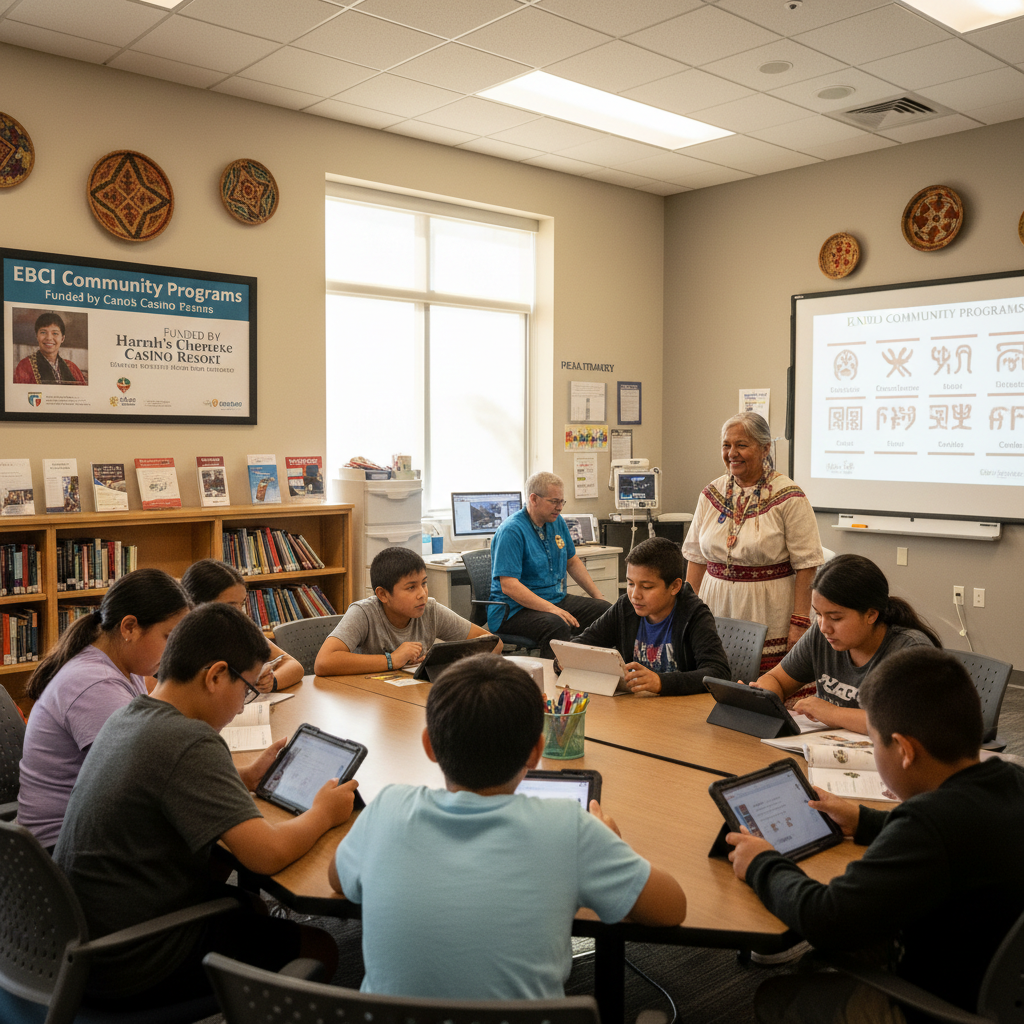
Harrah’s Cherokee Casino: How Tribal Gaming Revenue Fuels EBCI Sovereignty and Community
Key Takeaways
- Economic Independence: Gaming revenue allows the Eastern Band of Cherokee Indians (EBCI) to fund services independently of federal oversight.
- Comprehensive Support: Funding covers healthcare, higher education, language immersion, and elder services.
- Tribal Distinction: Harrah’s Cherokee properties are owned exclusively by the EBCI, not the Cherokee Nation or United Keetoowah Band.
- The Indian Gaming Regulatory Act (IGRA): The legal foundation that protects tribal gaming as an exercise of sovereignty.
Beyond the Neon: A New Era of Sovereignty
For the uninitiated, Harrah’s Cherokee Casino Resort in the Qualla Boundary might look like just another high-end gambling destination. But for the Eastern Band of Cherokee Indians (EBCI), those slot machines and poker tables are the engines of a modern-day revolution. We’re talking about more than just entertainment; we’re talking about sovereignty in action. For decades, tribal nations were forced to rely on the crumbs of federal budgets administered by the Bureau of Indian Affairs (BIA). Today, the EBCI is flipping the script, using gaming revenue to build a self-sustaining society that honors its past while securing its future.
Before we dive into the ledger of community programs, let’s get one thing straight: Osiyo.net is an independently operated information platform. We are not a tribal government site. If you are looking for official enrollment data or legal tribal business, you must go directly to the official tribal government offices.
A Tale of Three Tribes: Knowing Your Cherokee History
History isn’t always clean, and the history of the Cherokee people is often flattened by outsiders. To understand who owns and operates the Harrah’s Cherokee casinos, you must distinguish between the three federally recognized Cherokee tribes. Each is a distinct political entity with its own leadership, laws, and economic strategies.
- The Eastern Band of Cherokee Indians (EBCI): Based in North Carolina on the Qualla Boundary. They are the descendants of those who remained in the East during the Removal era. They own the Harrah’s Cherokee Casino Resort in Cherokee and Harrah’s Cherokee Valley River in Murphy.
- The Cherokee Nation (CN): Based in Tahlequah, Oklahoma. The largest of the three tribes, they operate their own gaming enterprise, Cherokee Nation Entertainment, which is separate from the EBCI’s Harrah’s partnerships.
- The United Keetoowah Band of Cherokee Indians (UKB): Also based in Oklahoma, the UKB has a distinct historical and political identity and has faced different regulatory paths regarding gaming.
When you spend money at a Harrah’s in North Carolina, you are supporting the EBCI specifically. For more on the differences between these nations, check our guide on tribal leadership structures.
The Legal Bedrock: IGRA and the Right to Game
Why do tribes have casinos in the first place? It isn’t a “special gift” from the government; it is an exercise of inherent sovereignty. The 1988 Indian Gaming Regulatory Act (IGRA) provided a statutory framework, but the right itself was affirmed by the Supreme Court. IGRA mandates that gaming revenue must be used for five specific purposes: funding tribal government operations, providing for the general welfare of the tribe and its members, promoting tribal economic development, donating to charitable organizations, and helping fund operations of local government agencies.
“Gaming is not an end in itself; it is a means to an end. That end is the health, education, and welfare of our people.” – General sentiment within EBCI leadership.
Where the Money Goes: Community Programs and Impact
The EBCI has one of the most robust Revenue Allocation Plans (RAP) in the country. While some tribes focus solely on government services, the EBCI balances individual payments with massive investments in the Qualla Boundary’s infrastructure.
1. Healthcare: The Cherokee Indian Hospital Authority (CIHA)
Perhaps the most visible success story of gaming revenue is the Cherokee Indian Hospital. Instead of waiting for the Indian Health Service (IHS) to provide adequate facilities, the EBCI used its own funds to build a state-of-the-art medical complex. This facility doesn’t just treat illnesses; it focuses on integrated care, behavioral health, and elder services. By taking control of their healthcare, the EBCI has significantly improved patient outcomes compared to the standard IHS model.
2. Education: The Gift of Knowledge
Through the EBCI’s gaming-funded education initiatives, tribal members have access to unprecedented opportunities. This includes funding for the Cherokee Central Schools and the Higher Education program, which provides scholarships and financial assistance for members to attend colleges and universities across the country. This isn’t just a handout; it’s an investment in the next generation of Cherokee lawyers, doctors, and engineers.
3. Language and Cultural Preservation
The edge of history is sharp, and for a long time, the Cherokee language was under threat of erasure. The Kituwah Preservation & Education Program (KPEP) is funded heavily by gaming revenue. This includes the New Kituwah Academy, a language immersion school where children learn to speak Cherokee fluently before they learn English. Gaming dollars pay the salaries of fluent speakers and develop the curriculum that keeps the culture alive. For more on the spiritual and cultural importance of this work, visit our section on Cherokee faith and culture.
Economic Impact and the ‘Per Capita’ Discussion
One of the most debated aspects of tribal gaming is the “per capita” payment. Twice a year, a portion of the casino profits is distributed directly to enrolled EBCI members. While critics often focus on these payments, they overlook the economic stimulus they provide to the surrounding Western North Carolina region. These payments help families cover mortgages, buy groceries, and invest in small businesses. However, the EBCI also places a significant portion of these funds into a minor’s trust, ensuring that young members have a financial foundation when they reach adulthood.
Comparison: Tribal Gaming Revenue Allocation
| Category | Focus Area | Typical Use Case |
|---|---|---|
| Government Operations | Administration | Tribal courts, law enforcement, fire departments. |
| Economic Development | Diversification | Investing in off-boundary real estate and non-gaming business. |
| Welfare Programs | Elder & Child Care | Heating assistance, nutritional programs, and childcare subsidies. |
| Per Capita | Direct Member Support | Bi-annual payments to enrolled citizens for personal use. |
The Future of EBCI Enterprise
The EBCI is not resting on its laurels. Through EBCI Holdings, the tribe is diversifying its portfolio, acquiring gaming properties outside the Qualla Boundary, such as in Indiana. This strategic move is designed to ensure that even if the local gaming market fluctuates, the funding for the Cherokee Indian Hospital and the New Kituwah Academy remains secure. This is sovereignty in the 21st century: using the tools of capitalism to protect the treasures of a culture that predates it.
FAQ
How much of the casino revenue goes to the tribe?
Under the tribal-state compact and IGRA, the tribe retains the net revenue after operating expenses and Harrah’s management fees are paid. This money is then allocated according to the EBCI’s Revenue Allocation Plan (RAP).
Can any Cherokee person get money from the casino?
No. Direct financial benefits and per capita payments are strictly limited to enrolled members of the Eastern Band of Cherokee Indians. Members of the Cherokee Nation and United Keetoowah Band have their own separate governments and economic programs.
Is Harrah’s the owner of the casino?
No. The EBCI owns the casino and the land. Harrah’s (Caesars Entertainment) is contracted to manage the operations. This partnership allows the tribe to leverage Harrah’s global brand and marketing reach while maintaining ownership.
Next Steps
- Visit the Qualla Boundary: Experience Cherokee culture firsthand by visiting the Museum of the Cherokee People and the Oconaluftee Indian Village.
- Learn About Citizenship: Understand the complexities of Cherokee citizenship and how it differs from mere ancestry.
- Stay Informed: Follow official EBCI government updates for the latest news on community projects and financial reports.
Last reviewed: June 2026
Osiyo.net is an independently operated information platform. Always verify enrollment information directly with the specific Tribal Nation.