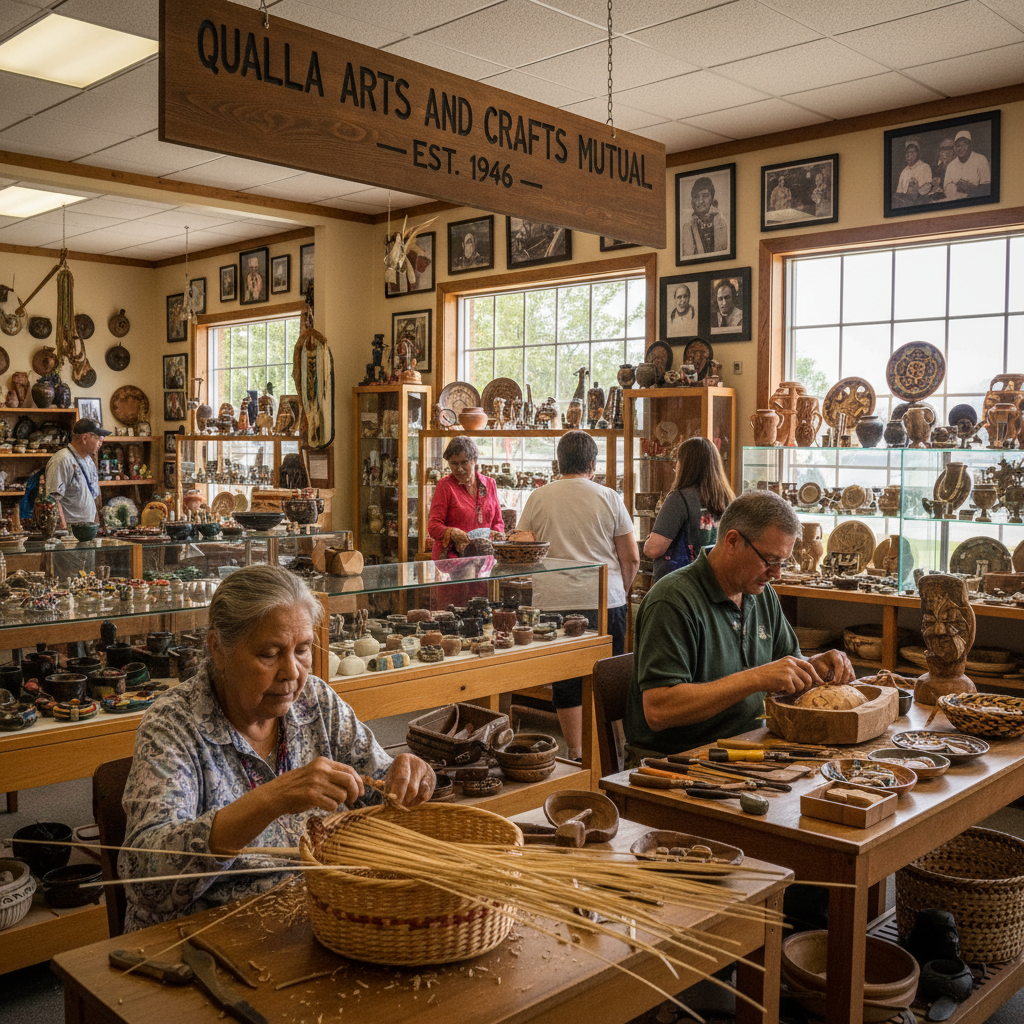
Qualla Arts and Crafts Mutual: The Sovereign Legacy of the Oldest Native American Cooperative
If you drive through Cherokee, North Carolina, you might be overwhelmed by the neon signs and the standard tourist fare that dots many mountain towns. But if you are looking for the soul of the Eastern Band of Cherokee Indians (EBCI), you stop at a low-slung, unassuming stone building on Tsali Boulevard. This is the Qualla Arts and Crafts Mutual. Founded in 1946, it isn’t just a gallery; it is the oldest Native American cooperative in the United States and a living testament to Cherokee resilience.
For those of us navigating the complexities of Cherokee identity and history, Qualla represents more than just a retail space. It represents economic sovereignty. At Osiyo.net, we believe in stripping away the myths and looking at the structures that keep our cultures alive. Qualla didn’t happen by accident; it was a calculated move to protect artists from exploitation and to ensure that the real Cherokee story—not the one sold in gift shops—was the one that endured.
Key Takeaways
- Founded in 1946, Qualla Arts and Crafts Mutual is the oldest Native American cooperative in the US.
- It is owned and operated by the artists of the Eastern Band of Cherokee Indians (EBCI).
- The cooperative serves as a critical defense against cultural appropriation and the sale of counterfeit “Indian” goods.
- Featured mediums include rivercane basketry, stamped pottery, and traditional woodcarving.
- Unlike the Cherokee Nation (Oklahoma) or the United Keetoowah Band, Qualla specifically focuses on the artisans of the Qualla Boundary in North Carolina.
The Birth of a Movement: 1946 and the Fight for Autonomy
To understand Qualla, you have to understand the post-war era in Indian Country. In the mid-1940s, Native artists were often at the mercy of middlemen who bought their work for pennies and sold it for a premium to tourists visiting the Great Smoky Mountains. There was no standard for quality, and there was certainly no protection for the intellectual property of the makers.
In 1946, sixty Cherokee artists came together with a radical idea: they would own the market. By forming a mutual cooperative, they took the power back from the trading posts. This wasn’t just a business move; it was an act of tribal leadership. They established rigorous standards for membership and quality, ensuring that if a piece carried the Qualla tag, it was authentic EBCI work.
“Qualla Arts and Crafts was a way for us to say that our culture is not a commodity for others to exploit, but a legacy for us to sustain.”
Distinguishing the Three Cherokee Nations
At Osiyo.net, we frequently see confusion regarding the three federally recognized Cherokee tribes. While the three tribes share a common linguistic and cultural ancestry, their modern political structures and art cooperatives are distinct. Qualla Arts and Crafts is specifically tied to the Eastern Band of Cherokee Indians (EBCI).
| Tribe | Location | Key Arts Organization | Historical Context |
|---|---|---|---|
| Eastern Band of Cherokee Indians (EBCI) | Cherokee, NC | Qualla Arts and Crafts Mutual | Descendants of those who remained in the mountains or returned. |
| Cherokee Nation (CN) | Tahlequah, OK | Cherokee Nation Cultural Tourism | The largest tribe; descendants of those removed on the Trail of Tears. |
| United Keetoowah Band (UKB) | Tahlequah, OK | UKB Tribal Museum/Arts | A distinct band emphasizing traditionalist Keetoowah identity. |
While members of the Cherokee Nation and UKB are prolific artists (often featured in Oklahoma-based galleries), Qualla is the institutional home for those living on the Qualla Boundary. For more on the differences in citizenship, see our guide on Cherokee Citizenship.
The Standards of Excellence: What Makes it Qualla?
You won’t find plastic beads or factory-made “dreamcatchers” at Qualla. The cooperative maintains a strict jury process. To be a member, you must be an enrolled member of the EBCI. This is a direct application of the Indian Arts and Crafts Act of 1990, a federal law that makes it illegal to market products as “Indian made” if they are not produced by a member of a federally recognized tribe.
The Art of the Rivercane
Perhaps the most prestigious medium at Qualla is Rivercane basketry. This is the oldest form of Cherokee weaving. Unlike white oak, which was adopted later, rivercane (Arundinaria gigantea) has been used for thousands of years. The process is grueling:
- Harvesting the cane in specific wetlands (many of which have been lost to development).
- Splitting the cane into four equal strips using only a knife and teeth.
- Dyeing the strips using natural plants like Bloodroot (red) and Black Walnut (brown/black).
- Weaving the complex “double-weave” technique—a basket within a basket that is water-tight.
Cherokee Pottery
While the Southwest is famous for its pottery, the Southeast has a tradition that is equally ancient but distinct. EBCI potters use the coiling method—not a wheel. The surfaces are often finished with a carved wooden paddle, creating intricate geometric stamps that date back to the Mississippian period. This isn’t just decor; it’s a topographical map of Cherokee cosmology.
The Defensive Wall Against Appropriation
Let’s get edgy for a moment: the market is flooded with fakes. From big-box retailers to “Native-inspired” boutiques, the exploitation of Cherokee aesthetics is a multi-million dollar industry. Qualla Arts and Crafts serves as the frontline defense. When you buy from the co-op, you are bypassing the “Pretendians” and the corporate vultures.
The cooperative ensures that the profit goes directly back to the artist and the community. This economic cycle supports education initiatives and ensures that the next generation of EBCI youth can afford to spend the time necessary to learn these complex, time-consuming crafts.
Qualla and the Modern Artist
While Qualla is rooted in tradition, it isn’t a museum of the dead. It is a living, breathing hub. Contemporary Cherokee artists are pushing boundaries, incorporating modern themes into traditional woodcarving and beadwork. You might see a traditional Booger Mask—used historically to represent outsiders or disease—carved with modern sensibilities, or beadwork that reflects the current political landscape of tribal opportunities and struggles.
Why Membership Matters
Membership in Qualla is a badge of honor. It requires not just talent, but proof of lineage. For those searching their own history, we recommend looking at our Final Rolls Search resources to understand how federal records have historically defined who is and isn’t included in these tribal narratives.
Visiting Qualla: A Guide for the Respectful Traveler
If you are planning a trip to the Qualla Boundary, make Qualla Arts and Crafts your first stop. It provides a baseline for quality. Once you see the depth of a real rivercane basket, the mass-produced versions in the tourist shops will look like exactly what they are: trash.
- Location: 645 Tsali Blvd, Cherokee, NC.
- Interaction: Many of the staff are artists themselves. Ask questions about the materials. They are the experts.
- Photos: Always ask before taking photos of specific works; these are the intellectual property of the artists.
FAQ
Is Qualla Arts and Crafts Mutual a government agency?
No. While it works closely with the Eastern Band of Cherokee Indians, it is an independent, member-owned cooperative. It is self-sustaining through its sales.
Can I buy Qualla items online?
Yes, the cooperative maintains an online presence, though the most unique and high-end pieces are often only available in person at the gallery in Cherokee, NC.
How do I know if the “Cherokee” art I bought elsewhere is real?
Check for a Certificate of Authenticity or a Qualla tag. If it was sold as “Native American made” but the artist isn’t named or their tribe isn’t specified, it likely violates the Indian Arts and Crafts Act. You can verify tribal status through official channels like BIA.gov.
Does Qualla represent the Cherokee Nation in Oklahoma?
Primarily, no. Qualla is dedicated to the artists of the EBCI. The Cherokee Nation has its own excellent galleries and retail outlets in Tahlequah and online via cherokee.org.
Next Steps
- Learn More: Explore our deep dive into The Three Federally Recognized Cherokee Tribes.
- Get Started: Thinking about your own heritage? Visit our Getting Started page.
- Support: Purchase directly from the Qualla Arts and Crafts Mutual official site.
Last reviewed: June 2026
Osiyo.net is an independently operated information platform. Always verify enrollment information directly with the specific Tribal Nation.