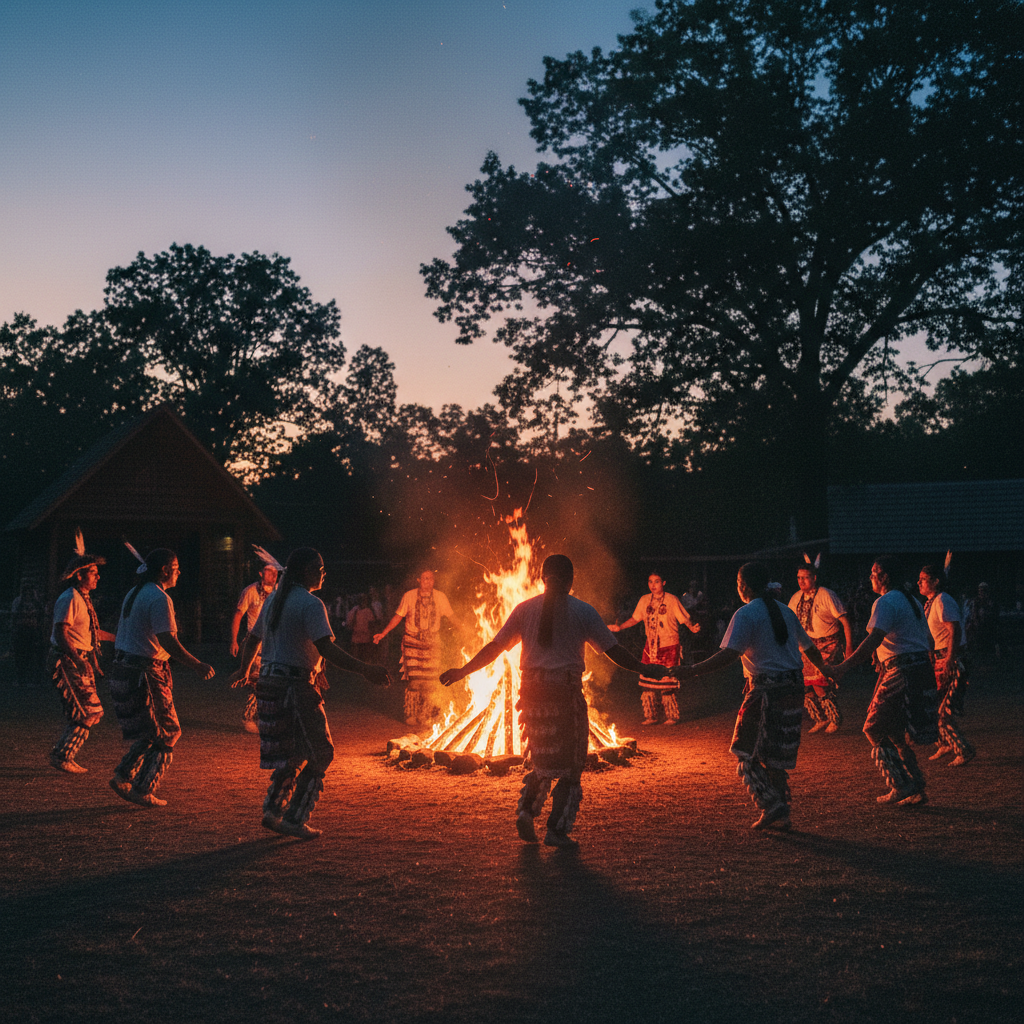
The Cherokee Stomp Dance: Community and Spirituality
Osiyo. When you hear the term Cherokee Stomp Dance, what comes to mind? For many outside our circles, it might conjure images from a history book or a snippet of a performance at a cultural festival. But for the Cherokee people, the Stomp Dance is not a performance. It is the heartbeat of a living, breathing community. It is a spiritual practice that has survived forced removal, federal bans, and the relentless pressure of assimilation. It is how we acknowledge our connection to the Creator, the Earth, and one another.
Before we dive into the smoke and the rhythm, let’s get something straight: Osiyo.net is an independently operated information platform. We are not an official arm of any Tribal Nation or the BIA. We’re here to provide resources on Cherokee and Tribal Nations research, genealogy, and culture. While we speak with deep respect for these traditions, we do not speak for the tribes. If you are looking for specific enrollment rules or ceremony schedules, you must contact the sovereign Tribal Nations directly.
Key Takeaways: Understanding the Stomp Dance
- Not a Performance: The Stomp Dance is a sacred ceremony, usually held at traditional ceremonial grounds, not a show for tourists.
- The Sacred Fire: Everything revolves around the fire, which represents the presence of the Creator and the sun on earth.
- Three Tribes, Shared Roots: While traditions vary, the Cherokee Nation, the Eastern Band of Cherokee Indians (EBCI), and the United Keetoowah Band of Cherokee Indians (UKB) all trace their ceremonial roots back to the same ancient Mississippian culture.
- Gender Roles: The dance relies on a partnership between men (who provide the song) and women (who provide the rhythm through shell shaking).
- Sovereignty Matters: Each Tribal Nation and each specific ceremonial ground is a sovereign entity with its own unique protocols and rules.
The Heart of the Ceremony: The Sacred Fire and the Ground
At the center of every traditional Cherokee Stomp Dance is the Sacred Fire. This isn’t just a campfire for warmth; it is a physical manifestation of the spiritual world. Traditionally, the fire is fed with wood from specific trees, and the four logs are oriented to the cardinal directions. The smoke from this fire carries the prayers of the people upward to the Creator.
The dance takes place on a specific piece of land known as the “ground.” In Oklahoma, where the Cherokee Nation and the United Keetoowah Band are located, these traditional grounds (often called “fires”) are the centers of community life for many families. Each ground has its own leadership, including a Town King (Miko), medicine people, and speakers. If you want to learn more about the organizational structures of our people, check out our guide on Tribal Leadership.
“The fire is the center of our universe. When we dance around it, we are moving in harmony with the sun and the stars, reminding ourselves that we are part of something much larger than our individual lives.”
The dance moves in a counter-clockwise direction, mirroring the movement of the sun. It is a physical prayer. When you participate (if invited) or observe, you aren’t just watching a dance; you are witnessing a commitment to the Gadugi spirit—the Cherokee concept of working together for the communal good.
The Rhythm of the Shell Shakers
If the fire is the heart, the Shell Shakers are the pulse. In the Cherokee Stomp Dance, the men sing the lead-and-response songs, but they do not provide the percussion. That vital role belongs to the women. Traditionally, women wear leg rattles made from dried box turtle shells filled with pebbles. In more recent times, some use condensed milk cans as a substitute, but the purpose remains the same.
The physical demand on a shell shaker is immense. They must maintain a steady, heavy rhythm for hours through the night, often until the sun rises. This isn’t just about musicality; it’s a form of spiritual endurance. The sound of the shells is said to represent the voice of the earth and the ancestors. It is a reminder of the maternal lineage that is so central to Cherokee identity. If you are researching your own maternal lines, our page on how to research Cherokee ancestry can help you navigate those historical records.
The Role of the Seven Clans
Cherokee society is traditionally matrilineal, organized into seven clans: Wolf, Deer, Bird, Long Hair, Paint, Blue, and Wild Potato. During major ceremonies, the seating around the dance circle (under the arbors) is often organized by clan. This ensures that the community remains balanced and that every family has a place at the fire. You can read more about these social structures in our section on Cherokee Stories and Traditions.
A History of Resilience: Surviving the “Religious Crimes Code”
It is impossible to talk about the Stomp Dance without addressing the