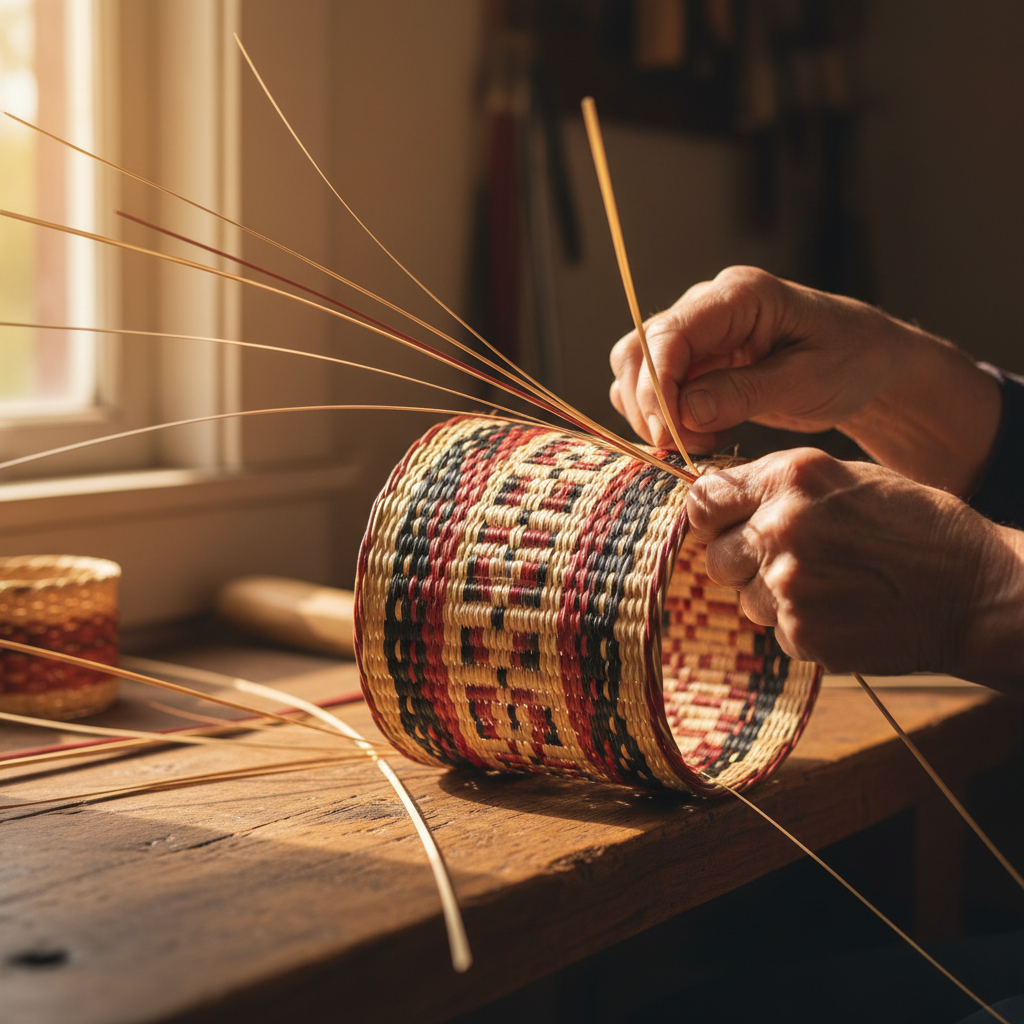
Cherokee Basket Weaving: Tradition and Craft
Osiyo! If you have ever held a Cherokee basket, you are holding more than just a container; you are holding ten thousand years of history, resilience, and sovereign identity. Cherokee basket weaving is one of the oldest and most sophisticated art forms in North America. It is a craft that survived the trauma of the Trail of Tears and the systemic pressure of boarding schools, yet it remains a vibrant, living practice among Cherokee people today.
Before we dive into the intricate patterns and the smell of fresh rivercane, we need to clarify a few things. Osiyo.net is an independently operated information platform. We are not an official website of any Tribal Nation, the Bureau of Indian Affairs (BIA), or any government agency. While we are passionate about Cherokee culture and tribal stories, each Tribal Nation is a sovereign government that sets its own rules for citizenship and cultural recognition. We never make eligibility claims—you must contact the specific tribe for enrollment matters.
Key Takeaways: The Heart of the Weave
- Ancient Origins: Cherokee basketry predates European contact by millennia, originally utilizing rivercane in the Southeastern homelands.
- Material Evolution: Forced removal shifted material usage, leading to the adaptation of honeysuckle and white oak in Oklahoma.
- The Three Tribes: Each of the three federally recognized Cherokee tribes (Cherokee Nation, Eastern Band of Cherokee Indians, and United Keetoowah Band) maintains unique basketry traditions.
- Legal Protection: The Indian Arts and Crafts Act of 1990 makes it illegal to sell items as “Indian produced” if they are not made by a member of a federally or state-recognized tribe.
- The Doubleweave: This legendary technique produces a basket with two distinct walls, a feat of mathematical and artistic mastery.
The Roots of the Craft: Rivercane and Resilience
In our original homelands in the Southeast—what is now North Carolina, Georgia, and Tennessee—the primary material for Cherokee basket weaving was rivercane (Arundinaria gigantea). This wasn’t just a choice of convenience; rivercane is a tough, glossy, and incredibly durable grass that grows in thickets known as canebrakes. The relationship between the Cherokee and the canebrakes was reciprocal. Weavers knew how to harvest without killing the plant, ensuring the brakes thrived for generations.
When the federal government forced the Cherokee people west on the Trail of Tears, the landscape changed. While some rivercane was found in the new Indian Territory (modern-day Oklahoma), it wasn’t as abundant as it had been in the East. This is where the “edge” of Cherokee survival comes in. Instead of letting the craft die, weavers adapted. They began using what was available: white oak splints and honeysuckle vines. This shift wasn’t just a change in material; it was an act of sovereignty. It was a refusal to let the disconnection from the land result in a disconnection from the culture.
The Science of Color: Natural Dyes
You won’t find neon plastics here. Traditional Cherokee baskets use colors pulled directly from the earth. To get these colors, weavers must also be botanists and chemists. They collect roots, bark, and hulls to create dyes that last for centuries.
- Black Walnut: The hulls of the walnut produce a deep, rich chocolate brown or black.
- Bloodroot: The roots of this delicate spring flower create a striking reddish-orange.
- Yellowroot: True to its name, this produces a vibrant, sunny yellow.
- Butternut: Often used for lighter tans and browns.
The process is labor-intensive. The materials must be gathered at the right time of year, boiled for hours, and then the splints or cane must be soaked until the color is permanent. When you see a high-quality basket today, you aren’t just paying for the weave; you’re paying for the days spent in the woods and over a boiling pot.
A Tale of Three Nations
While we often speak of “Cherokee” as a singular identity, it is vital to remember there are three distinct, sovereign Tribal Nations. Each has its own master weavers and subtle differences in style. For more on the political distinctions, check out our guide on three federally recognized Cherokee tribes.
1. The Eastern Band of Cherokee Indians (EBCI)
Located on the Qualla Boundary in North Carolina, EBCI weavers have the most direct access to the traditional rivercane. They are the primary keepers of the doubleweave technique. If you visit the Museum of the Cherokee People in Cherokee, NC, you will see rivercane baskets that look as though they were finished yesterday, even if they are over a century old.
2. The Cherokee Nation (CN)
Based in Tahlequah, Oklahoma, the Cherokee Nation has a robust community of weavers who primarily utilize white oak and honeysuckle. The “Oklahoma Style” of basketry often features intricate geometric patterns dyed with walnut. The Cherokee Nation’s Cultural Resource Center works tirelessly to preserve these techniques through community classes.
3. The United Keetoowah Band of Cherokee Indians (UKB)
The UKB, also in Oklahoma, maintains a deep focus on traditionalism. Their weavers often emphasize the spiritual connection to the materials, ensuring that the “old ways” are not lost to commercialization. For the UKB, basketry is a form of prayer and a method of maintaining Keetoowah identity.
The Holy Grail: The Doubleweave Technique
Imagine weaving a basket. Now, imagine weaving a second basket inside the first one, using the same continuous strands of cane, so that the basket has two walls and a seamless rim. That is the doubleweave. It is incredibly difficult. For a long period in the 20th century, the knowledge of the doubleweave was nearly lost, held by only a few weavers like Lottie Queen Stamper of the EBCI.
Today, the doubleweave has seen a resurgence. It is a point of pride for Cherokee basket weaving because it requires a level of mathematical precision and spatial reasoning that challenges any Western academic standard. It’s a reminder that Indigenous knowledge systems are complex, sophisticated, and intellectually rigorous.
“A basket isn’t just a physical object. It’s a map of our history. The patterns—like the ‘Chief’s Daughter’ or ‘Peace Pipe’—tell stories that go back further than any written book.” — Traditional Weaver Perspective
The Law and the Loom: The Indian Arts and Crafts Act
We need to talk about cultural theft. For decades, non-Indigenous people have mass-produced “Native-style” crafts, profiting off a culture they didn’t belong to while actual tribal members struggled to make a living. This isn’t just annoying; it’s a form of economic colonization.
To combat this, the federal government passed the Indian Arts and Crafts Act of 1990. This truth-in-advertising law prohibits misrepresentation in the marketing of Indian arts and crafts products within the United States. If someone sells a basket as “Cherokee,” they must be an enrolled member of a federally or state-recognized tribe. If you are looking to purchase a basket, always ask for the artist’s tribal affiliation. To learn more about the legalities of tribal identity, see our page on what is an Indian card.
Comparison of Materials
| Material | Region | Difficulty to Process | Key Characteristics |
|---|---|---|---|
| Rivercane | Southeast / NC | Very High | Hard, glossy, requires splitting into 4 or 8 pieces. |
| White Oak | Oklahoma / AR | High | Durable, requires heavy physical labor to harvest and split. |
| Honeysuckle | Oklahoma / NC | Moderate | Flexible, allows for very fine, detailed round weaving. |
| Maple/Ash | Various | Moderate | Often used as secondary splints or for specific decorative elements. |
Basketry and Your Family History
Often, people come to Osiyo.net because they found a basket in a great-grandparent’s attic and want to know if it proves they have Cherokee ancestry. While a basket can be a beautiful clue, it is not a legal document. Tribal enrollment is based on lineal descent from specific historical records, not the possession of cultural artifacts.
If a family heirloom has sparked your interest in your heritage, we recommend starting with official records. You can learn how to research Cherokee ancestry or dive into the Final Rolls index to see if your ancestors were documented during the allotment era. Remember, the journey of discovery is about more than a card; it’s about reconnecting with a living community.
FAQ: Common Questions About Cherokee Baskets
Can I learn Cherokee basket weaving if I am not Cherokee?
Many tribal members offer public workshops to share the appreciation of the craft. However, some techniques, particularly those involving sacred patterns or specific tribal traditions, may be reserved for tribal citizens. Always approach the craft with respect and avoid selling your work as “Indian-made” if you are not an enrolled member.
How can I tell if a basket is authentic?
Authentic Cherokee basket weaving usually features natural dyes and traditional materials like rivercane or white oak. Check for the artist’s name and tribal enrollment. You can also consult the Indian Arts and Crafts Board for a list of reputable galleries and shops.
Why are Cherokee baskets so expensive?
A single basket can represent weeks of labor. This includes finding the materials in the wild, processing them (splitting, scraping, cleaning), boiling dyes, and the actual weaving time. You aren’t just buying a basket; you are buying a piece of sovereign art and hours of a master artist’s life.
What do the patterns mean?
Common patterns include “The Chief’s Daughter,” “Man in the Coffin,” and “Peace Pipe.” These are not just decorative; they often represent historical events, social structures, or spiritual beliefs. Each weaver may have their own interpretation or variation of these patterns.
Next Steps: Support the Artists
If you’re ready to move beyond reading and start supporting the continuation of this craft, here is what you can do:
- Visit Official Sites: Plan a trip to Tahlequah, OK, or Cherokee, NC, to see these baskets in person. Check our travel guide for respectful visiting tips.
- Buy Directly: Look for tribal-run gift shops or artist cooperatives like Qualla Arts and Crafts Mutual.
- Verify: Always ask about the artist’s tribal nation before purchasing. If they can’t name a federally recognized tribe, walk away.
- Educate: Share what you’ve learned about the three Cherokee tribes and the importance of the Indian Arts and Crafts Act.
Cherokee basketry is a testament to the fact that we are still here. The hands that weave today are connected to the hands that wove before the first European ship ever touched these shores. That is the power of the craft.
Last reviewed: June 2026
Osiyo.net is an independently operated information platform. It is not an official website of any Tribal Nation, the Bureau of Indian Affairs, or any government agency. Always verify enrollment information directly with the specific Tribal Nation.