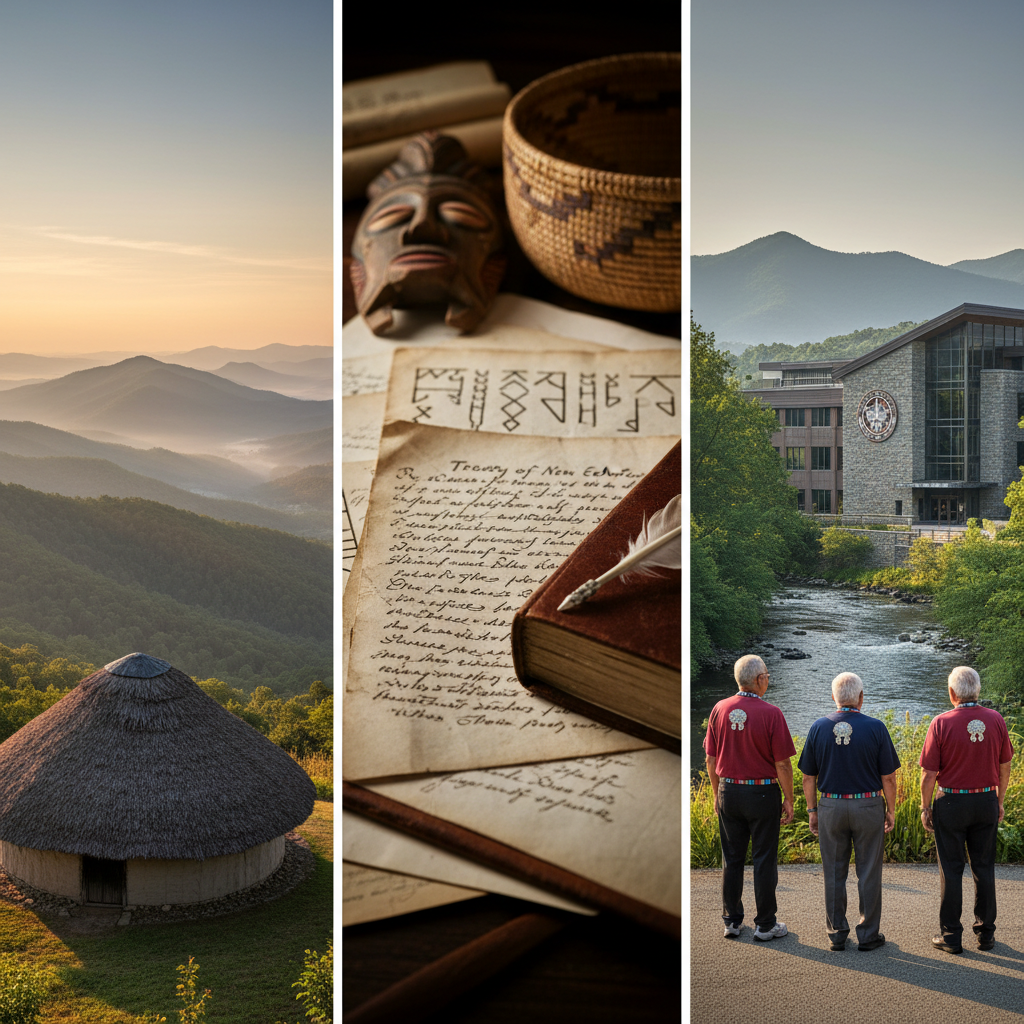
EBCI History: From Qualla Boundary to Modern Sovereign Nation
Most history books tell a single, linear story of the Cherokee: the tragic 1838 removal known as the Trail of Tears. But history is rarely a straight line, and for the Eastern Band of Cherokee Indians (EBCI), it is a story of those who refused to be erased from their ancestral landscape. The EBCI didn’t just ‘stay behind’; they fought, litigated, and sacrificed to remain in the Blue Ridge Mountains. Today, the Qualla Boundary stands as a testament to that stubborn, beautiful resilience. At Osiyo.net, we believe in getting the story right—beyond the myths and the simplified narratives. Note: Osiyo.net is an independent platform and not an official tribal government site.
Key Takeaways
- The EBCI consists of descendants of Cherokee who remained in the East after the 1838 forced removal.
- The Qualla Boundary is not a traditional ‘reservation’ but a land trust held by the federal government for the tribe.
- William Holland Thomas, a white ally and adopted member, played a crucial role in securing land for the tribe in the 19th century.
- The EBCI is one of three federally recognized Cherokee tribes, distinct from the Cherokee Nation (CNO) and the United Keetoowah Band (UKB).
- Sovereignty is the bedrock of the modern EBCI, fueled by economic diversification and cultural revitalization.
The Great Disturbance: Resistance and the Remnant
To understand the EBCI, you have to understand the 1830s. While the Treaty of New Echota (1835) was used as the legal (if fraudulent) basis to move the Cherokee people west, a small group of Cherokee in Western North Carolina had a different legal standing. Under earlier treaties, some had already claimed individual land allotments. Others lived in the rugged hills of the Oconaluftee River, far from the reach of the Georgia militia. When the roundups began, these families hid in the caves and steep ridges of the Great Smoky Mountains.
The story of Tsali is central to this era. Legend says Tsali and his family resisted capture, resulting in the death of a soldier. To ensure the rest of the ‘remnant’ Cherokee were allowed to stay, Tsali surrendered himself to be executed. While historians debate the specifics, the cultural impact is undeniable: the EBCI exists because people were willing to die for the right to live on their own soil. You can find more of these stories of survival throughout our archives.
The Thomas Legion and the Qualla Boundary
Post-removal, the Cherokee remaining in North Carolina were in a legal limbo. They weren’t quite citizens, and the state didn’t recognize their right to own land as a tribe. Enter William Holland Thomas. Thomas was a white businessman, lawyer, and adopted son of the Cherokee leader Yonaguska. Because the tribe could not legally hold title, Thomas used tribal funds and his own money to purchase over 50,000 acres of land in his own name for the Cherokee.
“The land was never a gift from the government. It was bought with Cherokee sweat and Thomas’s legal maneuvering, holding the ground until the federal government finally recognized the tribe’s inherent rights.”
This land eventually became the Qualla Boundary. Unlike many Western reservations created by executive order, the Boundary is land the EBCI specifically fought to keep. During the Civil War, Thomas organized the ‘Thomas Legion,’ a unit of Cherokee and white soldiers who served the Confederacy, primarily to protect their mountain territory from being overrun. This complex history is a far cry from the ‘passive victim’ trope often found in textbooks. Explore more about leadership and its evolution over the centuries.
Defining Sovereignty: The Three Sisters of the Cherokee
It is vital to distinguish between the three federally recognized Cherokee tribes. While they share a common heritage and language roots, they are separate sovereign nations with their own governments and enrollment criteria. To learn more about other nations, visit our tribes section.
| Tribe | Location | Approx. Population | Historical Context |
|---|---|---|---|
| Eastern Band of Cherokee Indians (EBCI) | North Carolina | 16,000+ | Descendants of the Remnant; Qualla Boundary. |
| Cherokee Nation (CNO) | Oklahoma | 450,000+ | The largest tribe; descendants of the Trail of Tears survivors. |
| United Keetoowah Band (UKB) | Oklahoma | 14,000+ | Descendants of the ‘Old Settlers’ who moved west before 1838. |
The EBCI’s path to federal recognition was unique. For decades, the North Carolina government tried to treat them as mere ‘citizens of color’ without tribal rights. It wasn’t until the late 19th and early 20th centuries that the federal government solidified the trust status of the Qualla Boundary, finally acknowledging the EBCI as a distinct sovereign entity. Understanding Cherokee citizenship requires knowing which of these three histories your ancestors were part of.
From Survival to Prosperity: The Modern Era
For much of the 20th century, the EBCI lived in what some might call ‘benign neglect’ or active poverty, with the local economy tied to seasonal tourism from the Great Smoky Mountains National Park. However, the late 1980s and 90s brought a seismic shift. The Indian Gaming Regulatory Act allowed the tribe to open Harrah’s Cherokee Casino. Let’s be clear: this wasn’t about ‘luck.’ It was a calculated exercise of sovereignty. The revenue from gaming has been funneled back into the community—building state-of-the-art hospitals, schools, and language immersion programs.
Today, the EBCI is a regional economic powerhouse. They have diversified into technology, hospitality, and even off-boundary investments. More importantly, they have used their resources to buy back sacred sites like Kituwah, the ‘Mother Town’ of the Cherokee people. Sovereignty isn’t just a legal term; it’s the ability to protect your culture and determine your own future. If you are looking to visit the region, check out our travel guide for respectful tourism.
The Baker Roll and Enrollment Realities
A frequent point of confusion involves the Baker Roll of 1924. This was the final allotment roll for the EBCI, intended to divide the land among members (though the land ultimately stayed in trust). Today, EBCI enrollment is based on being a direct lineal descendant of someone listed on the Baker Roll and meeting specific blood quantum requirements. If you are researching your genealogy, you might start with our final rolls search page to understand the historical records. Always verify current enrollment requirements directly with the EBCI Tribal Enrollment Office.
FAQ
Is the Qualla Boundary a reservation?
Technically, it is a ‘land trust.’ While it functions similarly to a reservation in terms of tribal jurisdiction, the land was purchased by the tribe and is held in trust by the federal government. It is not land ‘given’ to them by the U.S.
How do I join the EBCI?
Membership is governed strictly by the tribe. Generally, it requires a direct ancestor on the 1924 Baker Roll and a specific degree of Cherokee blood. Osiyo.net does not process applications; visit ebci.gov for official info.
What language does the EBCI speak?
The EBCI speaks the Kituwah (Eastern) dialect of the Cherokee language. There are aggressive revitalization efforts underway, including the New Kituwah Academy, an immersion school for children.
Can anyone live on the Qualla Boundary?
While many people visit for tourism, land within the Boundary is generally reserved for tribal members. Non-members can own businesses or work there, but residential land rights are a matter of tribal law.
Next Steps
If you’re looking to dive deeper into the world of the Cherokee and other Tribal Nations, here is how to continue your journey:
- Research Your Roots: Start with our getting started guide for indigenous research.
- Visit the Boundary: Head to Cherokee, NC, and visit the Museum of the Cherokee Indian to see these artifacts in person.
- Official Resources: Check out the Bureau of Indian Affairs for information on federal trust land.
- Stay Informed: Return to our home page for the latest updates on tribal sovereignty and cultural stories.
Last reviewed: June 2026
Osiyo.net is an independently operated information platform. Always verify enrollment information directly with the specific Tribal Nation.