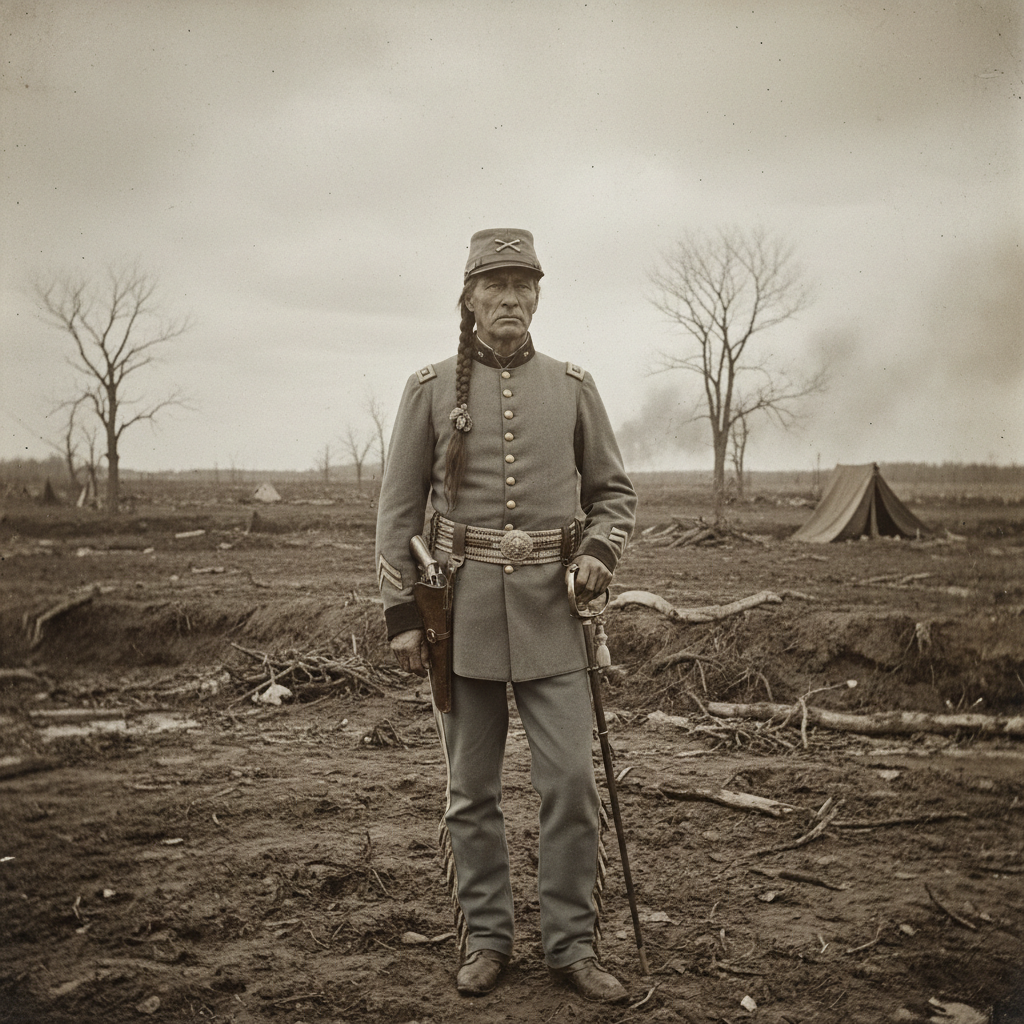
Stand Watie: Cherokee General and Complex Legacy
Osiyo! Welcome to Osiyo.net. If you are here, you are likely looking for the truth about one of the most polarizing figures in the history of the Cherokee people and the United States Civil War. Before we dive into the life of Stand Watie, let’s get the formalities out of the way: Osiyo.net is an independently operated information platform. We are not an official website of any Tribal Nation, the Bureau of Indian Affairs, or any government agency. Every Tribal Nation is a sovereign government that sets its own enrollment rules, and these rules vary significantly. If you are looking to enroll, you must contact the specific Tribal Nation directly.
When we talk about Stand Watie, we aren’t just talking about a man in a gray uniform. We are talking about a lightning rod for Cherokee politics, a survivor of an internal blood feud, and a leader who remains a hero to some and a villain to others. To understand Watie, you have to understand the impossible choices facing the Cherokee Nation in the 19th century. This isn’t a dry history lesson; it’s a story of survival, betrayal, and the grit of a man who was the last Confederate general to lay down his arms.
Key Takeaways
- Stand Watie (Degataga) was a leader of the Ridge Party and a signer of the Treaty of New Echota.
- He was the only Native American to achieve the rank of Brigadier General in the Confederate States Army.
- Watie was the final Confederate general to surrender, ending his campaign in June 1865.
- His legacy is deeply tied to the internal divisions within the Cherokee Nation that preceded and followed the Trail of Tears.
- Understanding Watie requires distinguishing between the three federally recognized Cherokee tribes today: the Cherokee Nation, the Eastern Band of Cherokee Indians, and the United Keetoowah Band of Cherokee Indians.
The Early Life of Degataga
Born in 1806 in Oothcaloga, Cherokee Nation (modern-day Georgia), Stand Watie was originally named Degataga, which translates to “He Stands Firm.” It was a prophetic name. His father was Uwatie, and his brother was Elias Boudinot, who would later become the editor of the Cherokee Phoenix. Watie grew up in a time of rapid change. The Cherokee were building a constitutional government, a written language (thanks to Sequoyah), and a thriving agricultural economy. However, the shadow of Georgia’s hunger for Cherokee land loomed over everything.
Watie was educated at the Brainerd Mission school, becoming literate in both Cherokee and English. He was a wealthy planter and a lawyer, deeply embedded in the political fabric of the nation. But the 1830s brought a crisis that would split the Cherokee people in two—a split that arguably has never fully healed.
The Great Schism: The Ridge Party and the Treaty of New Echota
Imagine being told your home, your land, and your government are being dissolved by a foreign power. That was the reality for the Cherokee. The leadership was divided. On one side was Principal Chief John Ross, who advocated for staying and fighting through the U.S. legal system. On the other was the “Ridge Party” (or Treaty Party), led by Major Ridge, John Ridge, Elias Boudinot, and Stand Watie.
The Ridge Party believed that the Cherokee would be annihilated if they stayed in the East. They made the agonizing decision to negotiate a removal treaty, believing they could save the people by moving West. In 1835, they signed the Treaty of New Echota. There was just one problem: they didn’t have the authority of the National Council to sign it. Most Cherokee saw this as a betrayal. Chief Ross and the majority of the nation petitioned against it, but the U.S. Senate ratified it anyway. This treaty provided the “legal” cover for the forced removal known as the Trail of Tears.
“I have signed my death warrant.” – Major Ridge, upon signing the Treaty of New Echota.
The consequences were immediate and bloody. In 1839, after the arrival in Indian Territory (modern-day Oklahoma), a group of Cherokee men executed Major Ridge, John Ridge, and Elias Boudinot for their roles in the treaty, citing a Cherokee law that made the unauthorized sale of land a capital offense. Stand Watie was the only leader of the Treaty Party to escape assassination. He spent the next two decades in a state of simmering civil war with the Ross faction.
The Civil War: A General in Gray
When the American Civil War broke out in 1861, the Cherokee Nation was once again caught in the middle. The Union had abandoned its forts in Indian Territory, leaving the tribes vulnerable to Confederate influence. While Chief John Ross initially tried to remain neutral, Stand Watie saw an opportunity. He raised a regiment of Cherokee volunteers for the Confederacy—the 1st Cherokee Mounted Rifles.
Why would a Cherokee leader fight for the South? It wasn’t just about the institution of slavery, though some wealthy Cherokee were enslavers. For many, it was about tribal sovereignty and the hope that a Confederate victory would lead to a better deal than the one the Union had offered. Watie was also motivated by his hatred for John Ross; if Ross leaned Union, Watie leaned Confederate.
Military Prowess and the Last Surrender
Watie wasn’t a traditional soldier who fought in neat rows. He was a master of guerrilla warfare. He harassed Union supply lines, captured steamships (like the J.R. Williams), and won a significant victory at the Second Battle of Cabin Creek in 1864, where he captured over $1 million worth of Union supplies. His success led to his promotion to Brigadier General on May 10, 1864.
While Robert E. Lee surrendered in Virginia in April 1865, Watie kept fighting. It wasn’t until June 23, 1865, at Doaksville in the Choctaw Nation, that Stand Watie finally surrendered his command. He was the last Confederate general in the field to do so.
Comparing the Leaders: Watie vs. Ross
| Feature | Stand Watie (Ridge Party) | John Ross (National Party) |
|---|---|---|
| Stance on Removal | Pro-Treaty (believed it was the only way to survive). | Anti-Treaty (believed in legal resistance in the East). |
| Civil War Allegiance | Confederate (Brigadier General). | Initially Neutral, then Union. |
| Post-Removal Status | Leader of the minority faction in Indian Territory. | Principal Chief of the Cherokee Nation. |
| Military Style | Guerrilla warfare, cavalry raids. | Diplomacy and political organization. |
The Aftermath: A Nation Rebuilding
The Civil War was a catastrophe for the Cherokee Nation. The people were divided, the land was ravaged, and the U.S. government used the Cherokee’s Confederate alliance as an excuse to strip away land and rights in the Treaty of 1866. This treaty, while punishing, did eventually reunite the nation under one government, though the internal divisions persisted for generations.
Watie spent his final years trying to rebuild his life and the lives of his followers. He died in 1871 and was buried in the Polson Cemetery in Delaware County, Oklahoma. His legacy remains a subject of intense debate. Was he a patriot who did what was necessary to save his people from total destruction? Or was he a traitor who signed away the ancestral homelands and fought for a cause (the Confederacy) that was inherently oppressive?
Researching Your Connection to the Era
If you believe your ancestors were involved with Stand Watie or were part of the Cherokee Nation during this tumultuous time, your journey starts with records. History isn’t just in books; it’s in the rolls and the archives.
Finding Your Ancestors
To begin, you should look into the Dawes Rolls and the Final Rolls of the Five Civilized Tribes. While these records come later (late 19th/early 20th century), they often list the parents and birthplaces of individuals, which can help you bridge the gap back to the Civil War era. If you are specifically looking for Confederate service records, the National Archives is an essential resource.
The Three Cherokee Tribes
It is vital to remember that Cherokee identity today is managed by three distinct, sovereign nations. Each has its own history and its own criteria for citizenship. You can learn more about these differences in our guide on the three federally recognized Cherokee tribes.
- Cherokee Nation (Oklahoma): The largest tribe, headquartered in Tahlequah. Citizenship is based on descent from the Dawes Rolls.
- Eastern Band of Cherokee Indians (North Carolina): Descendants of those who remained in the East or returned. They have a blood quantum requirement.
- United Keetoowah Band of Cherokee Indians (Oklahoma): A tribe that maintains a distinct cultural and political identity, also based in Oklahoma.
FAQ about Stand Watie
Was Stand Watie a traitor to the Cherokee people?
The answer depends on who you ask. To the followers of John Ross in the 1830s, he was a traitor for signing the Treaty of New Echota. To his supporters, he was a realist who saw that the only way to preserve the Cherokee people was to move West before the U.S. military forcibly removed them under worse conditions.
Why did Stand Watie fight for the Confederacy?
Watie’s decision was influenced by several factors: the Union’s failure to protect the Cherokee from local white settlers, the fact that the Cherokee were surrounded by Confederate states (Arkansas and Texas), and his personal political rivalry with the pro-Union John Ross.
Is Stand Watie the only Native American general?
He was the only Native American to achieve the rank of Brigadier General in the Confederate States Army. On the Union side, Ely S. Parker (a Seneca) also achieved the rank of Brigadier General and served as Ulysses S. Grant’s military secretary.
Where can I find records of Stand Watie’s soldiers?
The Compiled Service Records of Confederate Soldiers who served in organizations from the Indian Territory are available through the National Archives (BIA.gov often links to these resources) and sites like Fold3. You can also find valuable context in our Cherokee ancestry research guide.
Next Steps: Where to Go From Here
If you’re inspired to learn more about this era of Cherokee history, here are your action items:
- Visit the Cherokee National History Museum: Located in Tahlequah, Oklahoma, it offers a deep dive into the Civil War era from a Cherokee perspective.
- Search the Rolls: If you have family names from the 1800s, use the Final Rolls search tools to see if you can find a connection.
- Read the Treaties: Look up the actual text of the Treaty of New Echota and the Treaty of 1866 on the National Archives website to see the legal framework that shaped Watie’s life.
- Check Official Sites: For modern citizenship questions, always visit the official site of the Cherokee Nation, the Eastern Band of Cherokee Indians, or the United Keetoowah Band.
Stand Watie’s life reminds us that history is rarely black and white. It is made of people trying to make the best of impossible situations. Whether you view him as a hero or a cautionary tale, his impact on the Cherokee Nation and the history of the United States is undeniable.
Last reviewed: June 2026
Osiyo.net is an independently operated information platform. It is not an official website of any Tribal Nation, the Bureau of Indian Affairs, or any government agency. Always verify enrollment information directly with the specific Tribal Nation.