

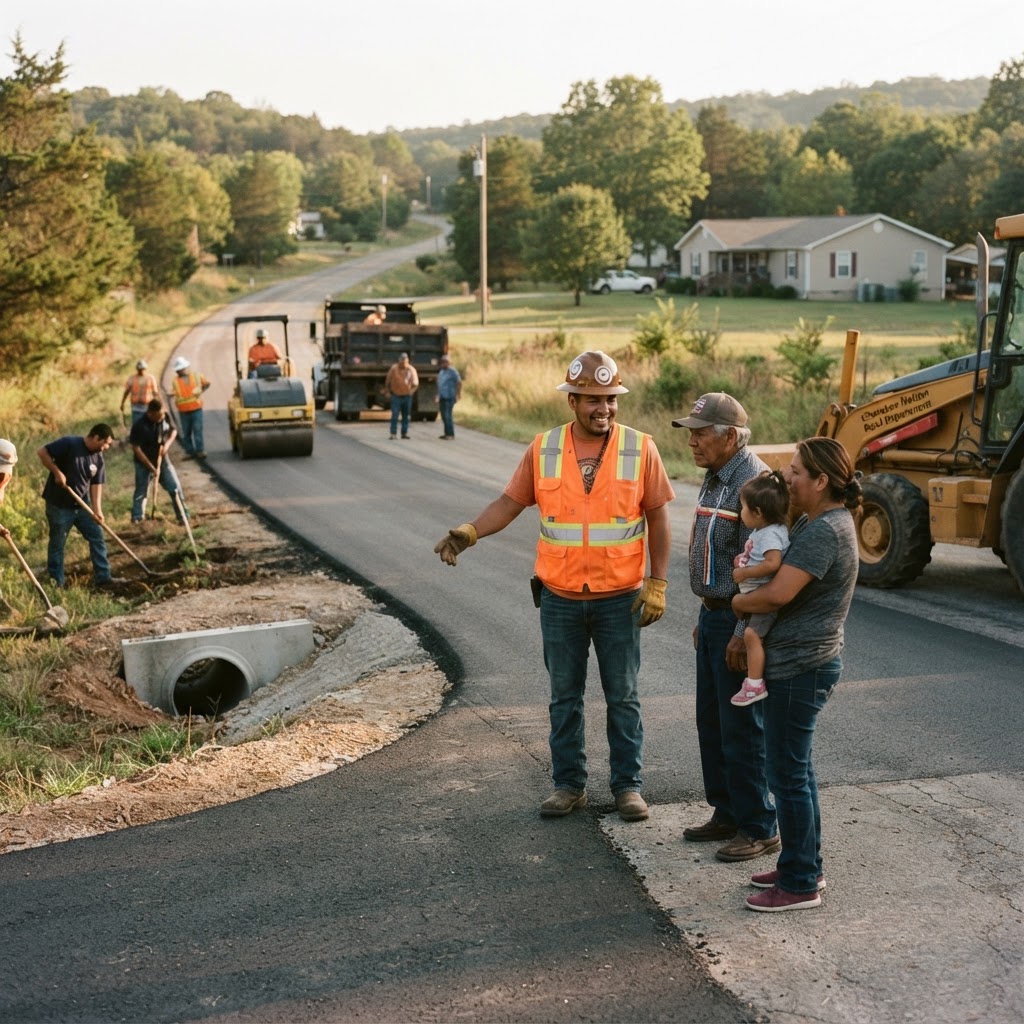
Sovereignty in Motion: Inside the Cherokee Nation Road Department
When most people think of tribal sovereignty, they think of courtrooms, high-stakes litigation, or perhaps the nuances of Cherokee citizenship. They don’t usually think of asphalt, gravel, and heavy machinery. But here is the reality: you can’t have a functioning nation if your people can’t get to work, kids can’t get to school, and emergency vehicles are stuck in the mud of a neglected county road. Infrastructure is the physical manifestation of self-determination.
The Cherokee Nation Road Department (part of the Department of Transportation) isn’t just a maintenance crew; it is a vital engine of community development across the 14-county reservation in Northeast Oklahoma. While colonizer-centric history books might suggest tribes simply “use” state resources, the truth is far more complex and impressive. The Cherokee Nation is a primary architect of the region’s safety and economic viability.
Key Takeaways
| Aspect | Detail |
|---|---|
| Primary Goal | Improve safety, accessibility, and economic growth via infrastructure. |
| Funding | Tribal Transportation Program (TTP), federal grants, and tribal revenue. |
| Jurisdiction | The 14-county reservation of the Cherokee Nation. |
| Key Partners | BIA, ODOT, and various Oklahoma county governments. |
More Than Just Paving: The Strategy of Connection
The Cherokee Nation Road Department manages a massive portfolio of projects that range from small bridge repairs to multi-million dollar highway expansions. In the Cherokee worldview, roads are arteries. If they are clogged or broken, the whole body—the community—suffers. This isn’t just about “fixing potholes”; it’s about strategic planning that looks 20 years into the future.
Because the Cherokee Nation’s reservation is a checkerboard of tribal, state, and private land, the Road Department must navigate a labyrinth of jurisdictional red tape. They don’t just work on “Indian Roads”; they partner with local counties to pave routes that benefit everyone living within the reservation boundaries, regardless of their status. This is a core tenet of being a good neighbor, a role the Nation takes seriously despite the historical irony of that position.
The 14-County Reservation Scope
The Department’s work covers thousands of miles. Whether it’s in Adair, Cherokee, or Sequoyah County, the presence of the Cherokee Nation’s investment is unmistakable. If you see a high-quality road in a rural area that the state seems to have forgotten, there’s a high probability tribal dollars put the steamroller there. You can learn more about the geographic reach of the three Cherokee tribes and their respective jurisdictions in our broader tribal guide.
“Infrastructure is the backbone of our economy. Without safe roads and bridges, our citizens cannot access healthcare, education, or employment opportunities.” – Common sentiment across Cherokee leadership.
Funding the Future: The Tribal Transportation Program (TTP)
How does a Tribal Nation pay for hundreds of miles of roadwork? It isn’t just through casino revenue, despite the popular (and often lazy) misconception. A significant portion of the funding comes through the Tribal Transportation Program (TTP), which is administered by the Bureau of Indian Affairs (BIA) and the Federal Highway Administration (FHWA).
The BIA Connection
The BIA’s Division of Transportation works with tribes to ensure that funding is distributed based on a formula that accounts for tribal population and road mileage. The Cherokee Nation has been a leader in “self-governance,” meaning they take those federal dollars and manage the projects themselves rather than letting a federal bureaucrat in D.C. decide which culvert gets replaced in Tahlequah.
Leveraging Tribal Dollars
Beyond federal funds, the Cherokee Nation often uses its own sovereign wealth to provide “matches” for grants. This allows them to pull in state and federal money that would otherwise be unavailable, effectively doubling or tripling the impact of every tribal dollar spent on infrastructure. This is what we call a “force multiplier” for economic opportunities in the region.
Three Tribes, Three Approaches
While this article focuses on the Cherokee Nation (the largest federally recognized tribe), it’s important to distinguish how infrastructure works for the other two Cherokee tribes. Sovereignty looks different depending on the land base.
- Cherokee Nation: Operates across a vast 14-county reservation with a complex mix of tribal and public roads. They are a major partner for the Oklahoma Department of Transportation (ODOT).
- Eastern Band of Cherokee Indians (EBCI): Located on the Qualla Boundary in North Carolina. Because their land is more concentrated and held in trust, their road management is often more localized but heavily integrated with the Great Smoky Mountains infrastructure. You can find more on them at ebci.gov.
- United Keetoowah Band (UKB): While the UKB share a jurisdictional area with the Cherokee Nation, their infrastructure focus often centers on specific tribal facilities and community centers rather than a broad road maintenance program. Check their latest at ukb-nsn.gov.
The “McGirt” Effect: Jurisdiction and Accountability
Since the landmark Supreme Court decision in McGirt v. Oklahoma and subsequent rulings like Hogner, the legal landscape of the Cherokee Nation Reservation has been reaffirmed. This has profound implications for infrastructure. When a reservation is legally recognized, the tribe’s seat at the table for federal transportation planning becomes much more prominent.
Critics often fear that tribal control means “lawlessness” or “broken roads,” but the opposite has proven true. The Cherokee Nation Road Department often maintains higher standards for construction and environmental impact than the surrounding jurisdictions. Why? Because they aren’t going anywhere. This land is home, not just a line item in a state budget that might get cut during the next legislative session.
Community Development: More Than Asphalt
The Road Department’s work spills over into other areas of tribal life. Safe roads mean:
- Better Education: School buses can navigate rural routes safely in inclement weather.
- Health Access: Citizens can reach Cherokee Nation health centers without fear of vehicle damage or impassable roads.
- Job Creation: The department itself employs hundreds of skilled workers—engineers, surveyors, and operators—many of whom are tribal citizens.
- Tourism: Enhancing the travel experience for those visiting historic Cherokee sites.
A Table of Recent Impact
| Project Type | Impact Area | Significance |
|---|---|---|
| Bridge Replacement | Rural Counties | Restores access for heavy farm equipment and emergency vehicles. |
| Safety Signage | Reservation-wide | Reduces traffic fatalities on rural intersections. |
| Pedestrian Walkways | Tahlequah/Community Centers | Improves walkability and public health. |
| Overlay & Resurfacing | High-traffic Corridors | Extends the life of critical economic arteries. |
FAQ
Does the Cherokee Nation only fix roads for tribal citizens?
No. The Cherokee Nation Road Department works on public roads within the reservation. If you drive in Northeast Oklahoma, you are likely driving on a road improved by tribal funds, regardless of your ethnicity or tribal affiliation.
Where does the money come from?
Funding is a mix of the federal Tribal Transportation Program (TTP), motor vehicle tag revenue (a major source of tribal pride), and general tribal funds. See the importance of the tribal tag for more context on how this works.
How can I report a road issue?
While Osiyo.net is an information platform and not a government entity, issues on tribal-maintained roads should be reported directly to the Cherokee Nation Department of Transportation via their official portal at cherokee.org.
Does the Road Department work with the State of Oklahoma?
Yes. They frequently enter into Intergovernmental Agreements (IGAs) with the Oklahoma Department of Transportation (ODOT) and various county commissioners to co-fund and co-manage large projects.
Next Steps
- Explore: Check out our community stories to see how infrastructure changes lives.
- Engage: If you are a citizen, look into tribal leadership updates on future infrastructure bond issues.
- Verify: Always visit the official Cherokee Nation website for the latest project maps and bidding opportunities.
Last reviewed: June 2026
Osiyo.net is an independently operated information platform. Always verify enrollment information directly with the specific Tribal Nation.