

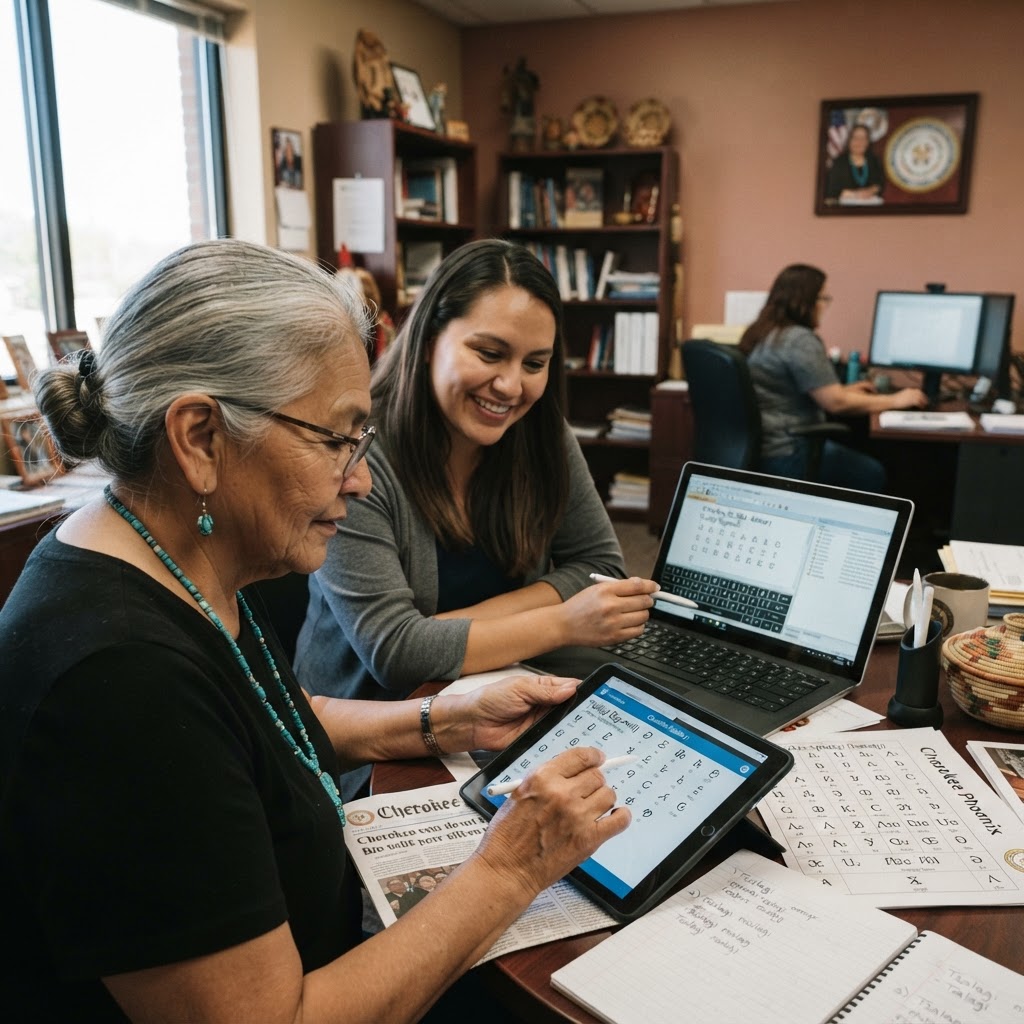
Digital Sovereignty: How Cherokee Nation Language Technology is Saving the Syllabary
For centuries, the Cherokee language (Tsalagi) has been the heartbeat of our people. From the smoke-filled councils of the old Southeast to the tech-integrated headquarters in Tahlequah, the language has survived because of one thing: adaptability. Today, we aren’t just fighting to keep Tsalagi alive in dusty archives; we are coding it into the future. Cherokee Nation Language Technology is not just a collection of apps—it is an act of digital sovereignty. This guide explores the cutting-edge tools, the historical struggles for Unicode representation, and the collective efforts of the three federally recognized Cherokee tribes to ensure our voice echoes in the digital void.
Osiyo.net is an independent platform dedicated to tribal resources. We are not an official government entity of any Cherokee tribe. For official government services, always consult the Cherokee Nation (cherokee.org), the United Keetoowah Band of Cherokee Indians (ukb-nsn.gov), or the Eastern Band of Cherokee Indians (ebci.gov).
Key Takeaways
- Sovereignty Through Tech: Language technology is a tool for self-determination, reducing reliance on external interpretations of Cherokee culture.
- Unicode is Foundation: Without Unicode standards, Cherokee characters wouldn’t display correctly across different devices and browsers.
- Three Tribes, One Mission: While the Cherokee Nation (CN) leads in tech integration, the Eastern Band of Cherokee Indians (EBCI) and United Keetoowah Band (UKB) play vital roles in preservation and traditional dialect archival.
- AI Integration: Partnerships with Microsoft and Google are bringing real-time translation and search capabilities to Tsalagi learners.
- Accessibility: Modern keyboards for iOS and Android have made Tsalagi a living language for social media and texting.
The Sequoyah Legacy in a Silicon World
To understand where we are going, you have to understand where we started. In 1821, Sequoyah completed the Cherokee syllabary. Critics—both white and Cherokee—thought he was crazy. They called it ‘witchcraft’ or ‘useless.’ He proved them wrong by creating a system so intuitive that the Cherokee people achieved a higher literacy rate than their white neighbors within a decade. That was our first technological revolution.
Fast forward to the late 20th century. As the world moved into digital spaces, the Cherokee syllabary faced a new threat: digital extinction. Early computers weren’t built for 86 characters that didn’t follow the Latin alphabet. We were at risk of being ‘orphaned’ by technology. The shift from lead type to pixels required a monumental effort to get the syllabary into Unicode, the international standard for encoding text. Today, because of the relentless work of linguists and tech advocates, your smartphone recognizes Cherokee as naturally as it does English or Mandarin. You can learn more about this journey in our section on Cherokee stories and historical resilience.
One Language, Three Sovereign Nations
While we share a language, it is crucial to distinguish between the three federally recognized Cherokee tribes, each of which utilizes technology in unique ways to serve their citizens. If you are looking for specific enrollment details or tribal services, please visit our Tribal Nations overview.
1. Cherokee Nation (Tahlequah, OK)
The Cherokee Nation is the largest of the three and has the most robust language technology department. They have spearheaded the integration of the syllabary into Apple, Google, and Microsoft products. Their focus is on scale—making the language available to hundreds of thousands of citizens globally through apps and online portals.
2. Eastern Band of Cherokee Indians (Cherokee, NC)
The EBCI focuses heavily on immersion. Their technological efforts often center on educational tools for the New Kituwah Academy. They use interactive tech to ensure the ‘Middle Dialect’ is preserved among the youth in their ancestral homelands. Their work is a testament to the power of place-based language preservation.
3. United Keetoowah Band of Cherokee Indians (Tahlequah, OK)
The UKB often focuses on the preservation of the traditional Keetoowah way of life. Their digital efforts involve archiving the voices of elder speakers and ensuring that the nuances of their specific linguistic heritage are not lost to the ‘standardization’ that sometimes happens in large-scale tech projects.
The Digital Toolkit: From Keyboards to AI
How do you actually use Cherokee today? It is easier than ever, thanks to a decade of aggressive development. Whether you are a fluent speaker or just starting at the beginning, these tools are essential.
"Technology is not the enemy of tradition. It is the new vessel for it. If our ancestors could use printing presses to fight for our land, we can use AI to fight for our language."
Mobile Keyboards and Operating Systems
In 2010, a major milestone was reached when Apple integrated the Cherokee syllabary into iOS. This wasn’t a charity move; it was the result of the Cherokee Nation’s leadership advocating for their people. Today, you can go into your settings on almost any modern device and add the Cherokee keyboard. This allows for ‘Tsalagi texting,’ keeping the language in daily use among the youth. If you’re wondering how this affects your ability to connect with the community, check our page on citizenship and community.
Microsoft Translator and AI
In 2021, the Cherokee Nation announced a partnership with Microsoft to include Cherokee in Microsoft Translator. This uses ‘Neural Machine Learning’ to provide high-quality translations. This is a game-changer for educators and students who need to translate large blocks of text or understand complex documents. However, the ‘edge’ here is awareness: AI is a tool, not a replacement for the soul of a fluent speaker.
Language Learning Apps
Several platforms now offer Cherokee-specific modules. Mango Languages and Memrise are two popular choices. These apps use gamification to help learners master the 86 characters of the syllabary and basic sentence structure. For those pursuing higher education or formal certifications, these apps serve as excellent supplements to classroom learning.
Comparison of Current Digital Tools
| Tool / Platform | Developer/Partner | Primary Function | Best For |
|---|---|---|---|
| Cherokee iOS Keyboard | Apple & Cherokee Nation | System-level input | Texting, Social Media |
| Microsoft Translator | Microsoft & CN | Neural Translation | Translating documents |
| Mango Languages | Mango | Educational Course | Beginners/Intermediate learners |
| Cherokee Unicode | Unicode Consortium | Standardization | Cross-platform compatibility |
| Online Syllabary Dictation | Various | Speech-to-text | Preserving elder speech |
Language Technology as an Act of Resistance
Let’s be real: for a long time, the goal of the U.S. government was to beat the Cherokee language out of our children in boarding schools. They wanted us silent and assimilated. Using digital tools to propagate Tsalagi is a direct middle finger to that legacy of erasure. When a Cherokee youth uses a smartphone to send a text in the syllabary, they are reclaiming a space that was once forbidden.
This is why data sovereignty is so important. As we feed our language into AI models, the tribes must ensure that they own that data. We shouldn’t just hand our linguistic heritage over to Big Tech without strings attached. The leadership within the tribes is increasingly focused on ensuring that Cherokee language technology remains by the people, for the people. This is part of the broader conversation about tribal identity and rights in the 21st century.
Next Steps: How to Get Involved
- Install the Keyboard: Go to your phone settings and add ‘Cherokee’ to your keyboards today. Start using it!
- Support Tribal Libraries: Many digital archives are funded by tribal initiatives. Visit our about page to see how we help direct you to these resources.
- Join a Class: Technology is better when paired with human interaction. Check out the Cherokee Nation’s online language classes.
- Stay Informed: Follow official tribal social media accounts for the latest updates on app releases and software patches.
Frequently Asked Questions
Is Cherokee on the Google Translate app?
As of now, Cherokee is not natively supported in the main Google Translate public interface in the same way it is on Microsoft Translator, though Google has worked on ‘Cherokee Search’ and other experimental projects with the tribe. Always use the Microsoft Translator for the most reliable neural translation currently available.
Do I need to be a tribal citizen to use these tools?
No. Most of these digital tools—keyboards, translation software, and many apps—are open to the public. The goal is to revitalize the language globally. However, some specific educational opportunities or specialized software may be reserved for citizens of the CN, EBCI, or UKB.
Does the UKB have different tech than the Cherokee Nation?
While the syllabary is the same, the UKB often focuses on preserving their specific Keetoowah dialect and cultural nuances. Most technical infrastructure (like Unicode) is shared across all Cherokee speakers, regardless of tribal affiliation.
How do I type the 86 characters on a standard keyboard?
Most Cherokee keyboards use a ‘phonetic’ layout. For example, typing ‘a-v’ might produce the corresponding Cherokee character. There are also ‘Syllabary’ layouts that display the characters directly on the screen for touch devices.
The Future of Tsalagi
The next frontier is the Metaverse and Virtual Reality (VR). Imagine an immersion program where you can walk through a digital 18th-century Cherokee village and interact with everything using Tsalagi voice commands. This isn’t sci-fi; it’s the direction Cherokee Nation Language Technology is heading. By securing our place in the digital world, we ensure that the voices of our ancestors continue to speak through the fingers of our descendants. If you’re ready to start your journey, visit Osiyo.net for more resources.
Last reviewed: June 2026
Osiyo.net is an independently operated information platform. Always verify enrollment information directly with the specific Tribal Nation.