

The Trail of Tears: Cherokee Removal and the Path to Indian Territory
Let’s start by stripping away the sugar-coating you might have found in a middle-school textbook. The Trail of Tears wasn’t just a sad walk in the woods; it was a state-sponsored campaign of ethnic cleansing, a massive land heist, and a profound test of Cherokee sovereignty. At Osiyo.net, we believe in telling the story straight—history with an edge, rooted in the facts of our ancestors’ survival. Before we dive in, remember: Osiyo.net is an independent information platform, not an official tribal government site. If you are looking for official records or enrollment, you must go directly to the source.
The Blueprint for Displacement: Not an Accident, a Policy
By the 1820s, the Cherokee Nation was far from the ‘primitive’ stereotype white settlers wanted to believe. We had a written constitution, a bilingual newspaper (the Cherokee Phoenix), and a centralized government. We were winning the game of ‘civilization’ by the settlers’ own rules. But the discovery of gold in Georgia and the election of Andrew Jackson changed the calculus. The Indian Removal Act of 1830 wasn’t just a piece of legislation; it was a weaponized tool of colonial expansion.
The Legal Gymnastics of Georgia
Georgia wanted Cherokee land, and they didn’t care about federal treaties. In a landmark case, Worcester v. Georgia, the Supreme Court actually ruled that the Cherokee Nation was a sovereign entity. Chief Justice John Marshall was clear: Georgia had no right to impose its laws on Cherokee land. But Jackson famously (or infamously) allegedly retorted, ‘John Marshall has made his decision; now let him enforce it.’ It was a constitutional crisis that sacrificed Cherokee lives at the altar of state greed.
“The Cherokee are a people who have been robbed of their country by a series of frauds, which the world has seldom seen equaled.” – General John Wool
The Treaty of New Echota: A Minority Rule
One of the most controversial moments in our history is the 1835 Treaty of New Echota. This wasn’t signed by the elected leadership of the Cherokee Nation. Instead, a small group known as the ‘Treaty Party’—including Major Ridge, John Ridge, and Elias Boudinot—signed it, fearing that total destruction was the only alternative to removal. Principal Chief John Ross and the vast majority of the people (over 15,000 signatories) protested the treaty as a fraud. The U.S. Senate ratified it anyway. If you’re researching your ancestors, understanding these factions is crucial to understanding the stories passed down in your family.
The Reality of the Trail
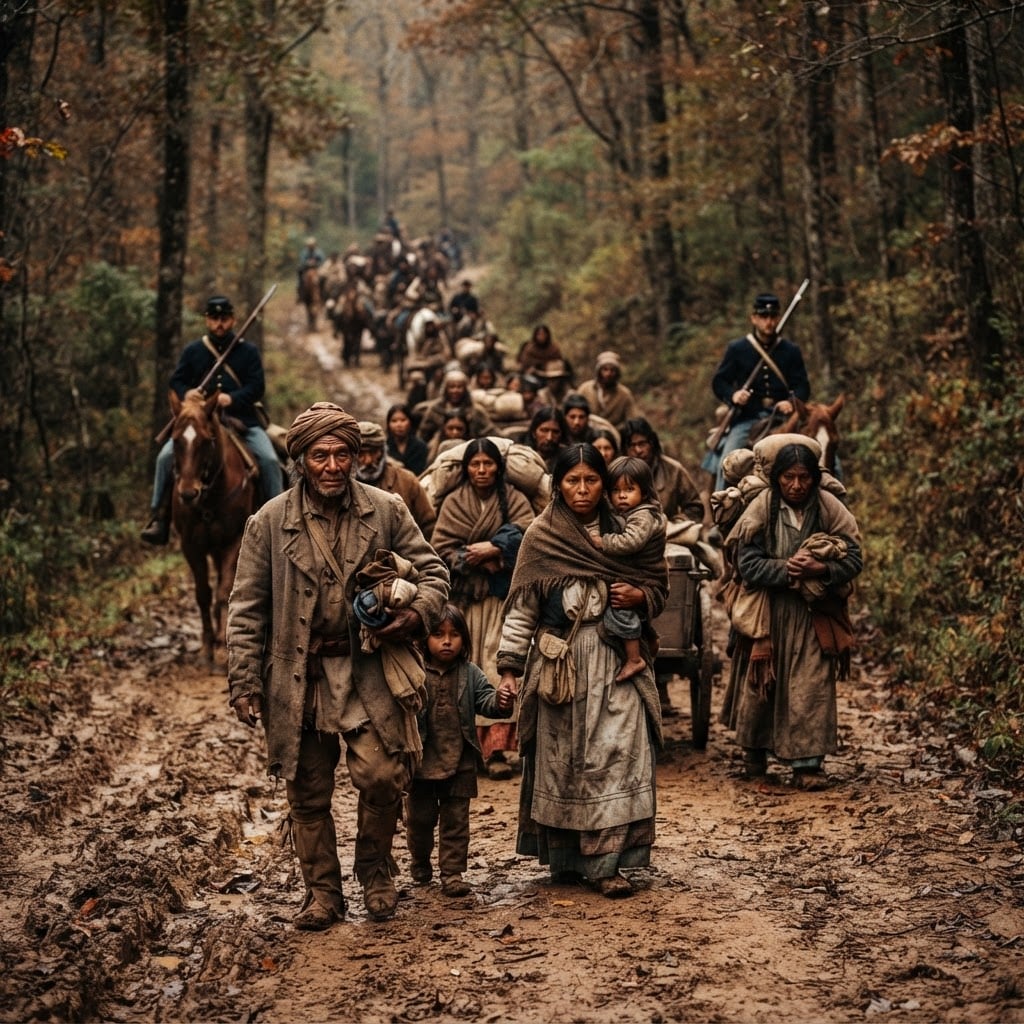
In 1838, the forced removal began under the command of General Winfield Scott. Cherokee people were rounded up at bayonet point, forced into stockades, and stripped of their possessions. The conditions were horrific—dysentery, cold, and starvation were constant companions.
Three Routes, One Destination
The ‘Trail’ wasn’t a single road. It consisted of several land and water routes:
- The Water Route: Utilized the Tennessee, Ohio, Mississippi, and Arkansas rivers. While faster, it was plagued by outbreaks of cholera.
- The Land Routes: Thousands traveled overland through Tennessee, Kentucky, Illinois, Missouri, and Arkansas. The ‘Northern Route’ was particularly brutal during the winter of 1838-1839.
- The Detachments: Eventually, Chief Ross gained permission for the Cherokee to manage their own removal, dividing the people into 13 detachments. While this allowed for more dignity, the environmental conditions remained lethal.
It is estimated that over 4,000 Cherokee died. That is one out of every four people who began the journey. They died in the stockades, on the roads, and shortly after arriving in ‘Indian Territory’ (modern-day Oklahoma). To learn more about identifying ancestors from this era, check out our guide on Final Rolls Search.
Sovereignty Divided: The Three Tribes Today
The Trail of Tears didn’t just move a people; it reshaped our political identity. Today, there are three distinct, federally recognized Cherokee tribes. Understanding the difference is key to understanding Cherokee sovereignty.
| Tribe | Location | Historical Context |
|---|---|---|
| Cherokee Nation (CN) | Tahlequah, OK | The largest tribe, descendants of those who survived the Trail of Tears. |
| United Keetoowah Band (UKB) | Tahlequah, OK | Descendants of the ‘Old Settlers’ who moved west before the forced removal. |
| Eastern Band of Cherokee Indians (EBCI) | Cherokee, NC | Descendants of those who remained in the mountains or returned after removal. |
The Rebirth in Tahlequah
When the Cherokee finally arrived in the west, they didn’t just collapse. They rebuilt. Tahlequah was established as the capital. Schools were built, including the Cherokee National Female Seminary—the first institution of higher learning for women west of the Mississippi. This resilience is the backbone of modern Cherokee leadership. We didn’t just survive; we adapted and thrived while maintaining our distinct identity.
Key Takeaways
- Forced Removal: The Trail of Tears was the result of the Indian Removal Act of 1830 and the fraudulent Treaty of New Echota.
- Sovereignty: The Supreme Court ruled in favor of the Cherokee, but President Jackson refused to enforce the law.
- Human Cost: Roughly 25% of the Cherokee population perished during the removal.
- Modern Identity: Today, the legacy lives on through three separate sovereign nations: CN, UKB, and EBCI.
Frequently Asked Questions
Was the Trail of Tears only for the Cherokee?
No. While the term is most closely associated with the Cherokee, the ‘Five Civilized Tribes’ (Cherokee, Chickasaw, Choctaw, Muscogee Creek, and Seminole) were all forcibly removed to Indian Territory. Each nation has its own unique and harrowing story of the Trail.
How can I find out if my ancestor was on the Trail?
Researching this requires looking at early census records and the ‘Old Settler’ rolls. However, most modern enrollment is based on the Dawes Rolls (late 1800s). You can start your journey at our Getting Started page or explore Cherokee Citizenship basics.
Where did the Trail of Tears end?
The various routes converged in what is now northeastern Oklahoma, primarily around Tahlequah and the surrounding districts of the old Cherokee Nation.
Next Steps
If you’re looking to deepen your connection to this history or explore your own heritage, we recommend these steps:
- Visit the official site of the Cherokee Nation to learn about current government affairs.
- Explore the cultural resources of the Eastern Band of Cherokee Indians.
- Consult the United Keetoowah Band for information on their unique history.
- Check out our Educational Resources to find books and documentaries that go beyond the basic history.
Last reviewed: June 2026
Osiyo.net is an independently operated information platform. Always verify enrollment information directly with the specific Tribal Nation.