

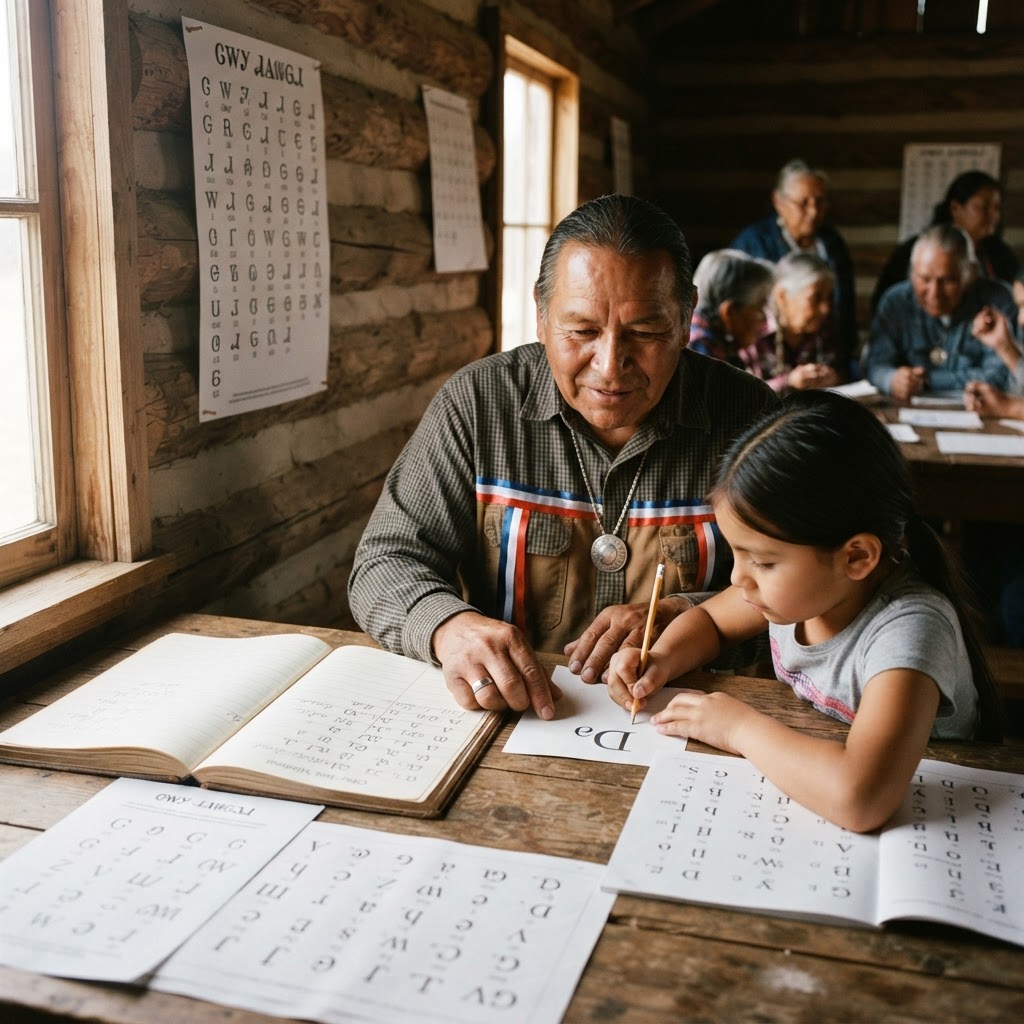
Sequoyah and the Cherokee Syllabary: The Intellectual Revolution of One Man
Osiyo. Let’s get one thing straight: Sequoyah didn’t just ‘stumble’ upon a written language. He didn’t have a vision from the clouds. He was a silversmith, a veteran, and a genius who looked at the ‘talking leaves’ of white settlers and decided the Cherokee people deserved better. In a world that often treats Indigenous history as a series of tragedies, the story of the Cherokee Syllabary is a thunderclap of intellectual sovereignty. It is the only recorded instance in history of a member of a non-literate people creating an entirely new, effective writing system from scratch without prior knowledge of another script.
Key Takeaways
- Originality: Sequoyah’s system is a syllabary, not an alphabet, making it uniquely suited to the Cherokee language.
- Speed of Adoption: Within a decade of its introduction, the Cherokee people achieved a higher literacy rate than neighboring non-Native settlers.
- Sovereignty: The syllabary was a political tool that helped the Cherokee Nation argue for their rights in the American legal system.
- Modern Usage: Today, all three federally recognized tribes—the Cherokee Nation, the Eastern Band of Cherokee Indians (EBCI), and the United Keetoowah Band of Cherokee Indians in Oklahoma (UKB)—continue to use and teach the syllabary.
The Myth of the ‘Illiterate’ Inventor
Western history books love the trope of the ‘civilized’ Indian, but Sequoyah (also known as George Gist) wasn’t looking for approval. Born around 1770 in the village of Tuskegee, he was a craftsman who saw how the written word empowered European settlers. He called their books and letters ‘talking leaves.’ While some of his peers believed these were gifts from the gods or a form of sorcery, Sequoyah knew better. He saw it as a tool—and one that he could improve upon.
“If I can make these marks talk, the Cherokee people will be as strong as any nation on earth.” — Attributed to Sequoyah
The road wasn’t easy. Sequoyah spent twelve years obsessed with his task. He neglected his farm and his family. His neighbors thought he had lost his mind; some even suspected him of witchcraft. His wife, frustrated by his obsession, famously burned his early work, forcing him to start over. But Sequoyah wasn’t deterred. He simplified thousands of pictographic concepts into just 85 (originally 86) characters that represented the sounds of the Cherokee language.
How the Syllabary Works
To understand Sequoyah’s genius, you have to understand the difference between an alphabet and a syllabary. In the English alphabet, characters represent individual phonemes (sounds). In a syllabary, each character represents a whole syllable—usually a consonant followed by a vowel. This makes the language much easier to learn for native speakers because you are writing the sounds exactly as you say them.
The Mechanics of Sound
The Cherokee language is composed of six vowels and several consonants. By combining these, Sequoyah created a system where if you could speak Cherokee, you could learn to read it in a matter of weeks, not years. This was a radical departure from the complex spelling rules of English.
| Feature | English Alphabet | Cherokee Syllabary |
|---|---|---|
| Type of System | Alphabetic (Phonemic) | Syllabic |
| Number of Characters | 26 | 85 |
| Learning Curve | Years to master spelling | Weeks for native speakers |
| Origins | Evolved over millennia | Created by one man in 12 years |
The Trial of Ayoka
The turning point for the Cherokee people came in 1821. Sequoyah brought his young daughter, Ayoka, before the Cherokee Council. He had taught her the system in secret. To prove its effectiveness, the Council separated the two. Sequoyah wrote down whatever the leaders told him, and then Ayoka was brought back in to read the messages. She read them perfectly. The skeptics were silenced. Within months, the Cherokee people were teaching one another in homes, in the fields, and along the trails.
For more on how these historical moments shape tribal identity today, explore our section on Cherokee Stories.
The Three Tribes and the Syllabary Today
While the history of the Cherokee people is marked by the forced removal known as the Trail of Tears, the syllabary remained a unifying force. It is important to distinguish the three federally recognized Cherokee tribes, as each has its own sovereign government and language preservation programs:
- Cherokee Nation (Oklahoma): The largest of the three, based in Tahlequah. They have pioneered digital integration of the syllabary, working with tech giants like Apple and Google. Learn more at cherokee.org.
- Eastern Band of Cherokee Indians (North Carolina): Descendants of those who remained in their ancestral homelands in the Qualla Boundary. They focus heavily on immersion schools. Visit ebci.gov.
- United Keetoowah Band of Cherokee Indians (Oklahoma): A tribe that maintains a strong focus on traditional Keetoowah ways and language. More info at ukb-nsn.gov.
Each of these nations views the syllabary not just as a way to communicate, but as a primary marker of tribal sovereignty.
The Cherokee Phoenix: Sovereignty in Print
By 1828, the Cherokee Nation had established its own newspaper, the Cherokee Phoenix. This was the first Native American newspaper published in the United States. It used a custom-made printing press with Cherokee type. This wasn’t just about sharing news; it was a political statement. By publishing their laws and their constitution in their own language, the Cherokee proved to the world they were a sophisticated, literate nation. It was a shield against the legal arguments used by those who wanted to steal Cherokee land by claiming they were ‘uncivilized.’
Today, students can still study these documents as part of Native Education initiatives across the country.
Common Misconceptions
Myth: Sequoyah was half-white, so he must have used English as a base.
Truth: While his father was likely a white fur trader, Sequoyah did not speak, read, or write English. He intentionally avoided the English alphabet’s logic, though he did adapt some Roman letters he saw in books for their shapes—often turning them upside down or modifying them to fit his 85 sounds.
Myth: The syllabary is a dead language.
Truth: The syllabary is very much alive. It is on road signs, in digital apps, and used in ceremonial life. Language revitalization is a cornerstone of modern tribal leadership.
Next Steps
If you are interested in learning more about the Cherokee language or the history of the three tribes, here are your next moves:
- Visit the Osiyo.net homepage for a directory of Cherokee resources.
- Check out our guide on Cherokee Citizenship to understand the distinction between culture and legal tribal status.
- Explore the history of Cherokee heritage sites in North Carolina, Georgia, and Oklahoma.
Frequently Asked Questions
Is the Cherokee Syllabary hard to learn?
For native speakers, it is remarkably intuitive. For English speakers, the challenge lies more in the sounds of the language than the characters themselves. Many resources are available through the education portals of the three tribes.
Why are there 85 characters?
Each character represents a unique combination of a consonant and a vowel found in the Cherokee language. Sequoyah originally had 86, but one was dropped as the system was refined for the printing press.
Did Sequoyah ever live to see the Trail of Tears?
Yes. Sequoyah moved west to Arkansas and then to Indian Territory (modern-day Oklahoma) before the main forced removals. He spent his final years searching for lost bands of Cherokee in the Southwest and Mexico, where he died in 1843.
Can I find my ancestors’ names in the syllabary?
Many official records from the 19th century were kept in the syllabary. If you are researching your family history, you might encounter it. You can start your genealogical journey at our Final Rolls Search page.
Last reviewed: June 2026
Osiyo.net is an independently operated information platform. Always verify enrollment information directly with the specific Tribal Nation.