

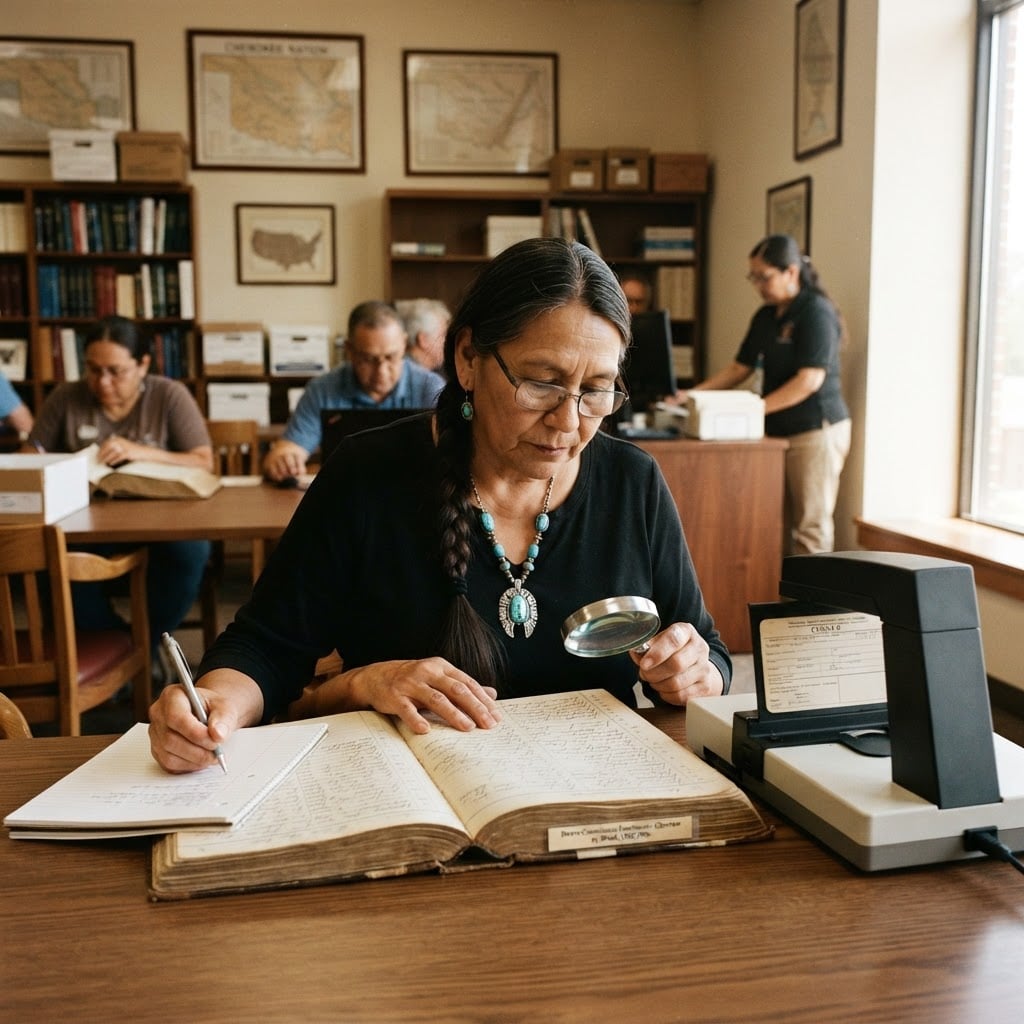
Dawes Commission Rolls: The Hard Truth About Researching Cherokee Ancestry
Forget the family legend about the “Cherokee Princess” grandmother who hid in the mountains. If you are serious about tracing Cherokee ancestry, you need to step away from the oral myths and step into the cold, hard bureaucratic reality of the Dawes Commission Rolls. At Osiyo.net, we don’t do fluff. We provide the historical context and the roadmap for navigating one of the most significant—and controversial—genealogical records in American history. This isn’t just about names on a page; it is about a massive settler-colonial project that unintentionally became the gatekeeper for modern tribal citizenship.
Key Takeaways
- The Dawes Commission (1893–1914) was created to divide tribal lands into individual allotments.
- The “Final Rolls of the Five Civilized Tribes” are the primary documents used for citizenship in the Cherokee Nation and United Keetoowah Band today.
- Being on the roll required living in Indian Territory (modern-day Oklahoma) during the enrollment period.
- The Eastern Band of Cherokee Indians (EBCI) uses the 1924 Baker Roll, not the Dawes Roll.
- Osiyo.net is an independent platform, not a tribal government entity.
What Exactly Was the Dawes Commission?
In the late 19th century, the U.S. government decided that tribal sovereignty and communal land ownership were obstacles to “civilization” (read: white settlement). The General Allotment Act of 1887, also known as the Dawes Act, paved the way. The Dawes Commission was established to negotiate the extinguishment of tribal land titles for the Five Civilized Tribes: the Cherokee, Choctaw, Chickasaw, Creek, and Seminole. Its mission was to create a definitive list of tribal members to distribute 160-acre parcels of land to each individual. This process effectively ended communal land ownership and attempted to force indigenous people into a European-style model of private property. To learn more about the broader landscape of tribal structures, check out our guide on federally recognized tribes.
The Curtis Act of 1898
If you think the tribes just handed over their membership lists, think again. The Cherokee Nation resisted this intrusion fiercely. It took the 1898 Curtis Act to strip the tribes of their right to determine their own membership for allotment purposes, giving the Dawes Commission the power to create the rolls themselves. This was a direct assault on sovereignty, and the records we use today for genealogy are the remnants of that struggle. If you are just beginning this journey, you might want to start with our beginner’s guide to Cherokee research.
The Three Tribes: Who Uses the Dawes Rolls?
One of the most common misconceptions is that all Cherokee people are part of the same legal entity. There are three distinct, federally recognized Cherokee tribes, and they have very different requirements for citizenship. It is vital to understand which one your ancestors might have belonged to.
| Tribe | Location | Primary Enrollment Record |
|---|---|---|
| Cherokee Nation (CN) | Tahlequah, OK | Dawes Rolls (Final Rolls) |
| United Keetoowah Band (UKB) | Tahlequah, OK | Dawes Rolls (minimum 1/4 blood quantum) |
| Eastern Band of Cherokee Indians (EBCI) | Cherokee, NC | 1924 Baker Roll |
As you can see, the Dawes Rolls are primarily relevant for those with ancestors who moved to (or remained in) Indian Territory during the Trail of Tears or shortly thereafter. If your ancestors remained in North Carolina, the Dawes Commission likely never saw them. For more details on the legalities of this, visit our page on Cherokee citizenship requirements.
Navigating the Categories of Enrollment
When you look at the Dawes Rolls, you aren’t just looking for a name. You are looking for a category. The Commission divided applicants into several groups, and where your ancestor landed matters immensely for historical context and modern research.
Cherokee by Blood
These are individuals whom the Commission determined had biological Cherokee ancestry. They were assigned a “blood quantum”—a mathematical fraction of how “Indian” the Commission thought they were. It is important to remember that blood quantum was a tool of the federal government, not a traditional Cherokee concept. You can search these names through our Final Rolls search resources.
Cherokee Freedmen
The Cherokee Freedmen were individuals of African descent who were formerly enslaved by Cherokees or were descendants of those enslaved people. Under the Treaty of 1866, they were granted full citizenship rights within the Cherokee Nation. Their records are found on the Freedmen section of the Dawes Rolls. The history of the Freedmen is a complex and often edgy topic in tribal politics, reflecting centuries of legal battles over sovereignty and inclusion.
Intermarried Whites
White individuals who were legally married to Cherokee citizens prior to a specific cutoff date (usually November 1875) were sometimes eligible for enrollment as “Intermarried Whites.” They received land allotments but are listed with a blood quantum of “IW” or zero. Note that their descendants are generally not eligible for tribal citizenship unless they also have a direct ancestor on the “Cherokee by Blood” roll.
How to Search the Records: A Step-by-Step Guide
Don’t just Google “am I Cherokee.” You need to be methodical. The Dawes Commission records are housed at the National Archives (NARA), but many are available through digital databases.
Step 1: Identify the Ancestor
You need a name of an ancestor who was alive and living in Indian Territory between 1898 and 1906. If your ancestor died in 1880, they won’t be on the Dawes Roll. If they were born in 1920, they won’t be on the Dawes Roll (though they might be listed as a minor or on later supplemental records).
Step 2: Find the Census Card
The Census Card (also called an Enrollment Card) is the holy grail. It lists the head of the household, their spouse, their children, and often the names of their parents. It will also list their “D” number (Dawes number). This card is the summary of their application. You can find more about obtaining these documents on our Indian Card information page.
Step 3: Analyze the Application Jacket
The “jacket” contains the actual testimony given by the applicant. This is where the real history lives. You might find transcripts of interviews where your ancestor describes their family tree, where they lived, and who their relatives were. This is the best way to separate fact from family fiction.
“The Dawes Commission was not a genealogical service; it was a legal proceeding. Every name on that roll was vetted with the scrutiny of a court case.”
Common Pitfalls and Misconceptions
Researching the Dawes Rolls is notoriously frustrating. Here is why most people get stuck:
- Rejected Applications: Thousands of people applied and were rejected. Being in the “Rejected” files (often called the “R” rolls) does not qualify a person for citizenship today. It means the Commission found they did not meet the criteria at the time.
- Misspellings: Names were often recorded phonetically by government clerks who didn’t speak Cherokee. Try every variation of a surname you can imagine.
- The “Princess” Myth: We will say it again: DNA tests like AncestryDNA or 23andMe do not count as proof for tribal enrollment. The tribes rely on lineal descendancy from the Dawes or Baker Rolls, not a percentage on a pie chart.
- The Wrong Roll: If your ancestors were in Alabama or Georgia in 1900, they aren’t on the Dawes Roll. Period. They might be on the Guion Miller Roll (which was for a 1906 lawsuit), but that is a different story for another day.
The Significance of the Records Today
For many, finding an ancestor on the Dawes Rolls is a moment of deep connection to their past. It is a way to reclaim a history that was nearly erased. For others, it is the first step toward seeking citizenship in the Cherokee Nation or the United Keetoowah Band. Whatever your motivation, remember that these records represent a time of immense upheaval and survival. Read some of the personal accounts in our Cherokee stories section to get a sense of the resilience of the people listed on these rolls.
FAQ
1. Can I use a DNA test to prove my Cherokee ancestry?
No. While DNA tests can suggest indigenous heritage, they cannot tell you which tribe you belong to, nor are they accepted by any of the three federally recognized Cherokee tribes for citizenship. You must prove descendancy through historical records like the Dawes Roll.
2. What if my ancestor was Cherokee but refused to sign the Dawes Roll?
This did happen. Some “Old Settlers” or traditionalists resisted the government’s census as a matter of principle. However, because the rolls are “Final,” if an ancestor is not on the roll, their descendants are typically unable to claim tribal citizenship today, regardless of their biological heritage.
3. What is the difference between the Dawes Roll and the Guion Miller Roll?
The Dawes Roll (1898-1914) was for land allotment and is the basis for citizenship. The Guion Miller Roll (1906-1911) was created to distribute a $1 million settlement for a lawsuit regarding previous treaties. Many people are on both, but some who didn’t qualify for Dawes (because they lived outside Indian Territory) might appear on the Miller roll.
4. How do I know if I am looking at the Cherokee Nation or the Eastern Band?
Geography is the biggest clue. If your family was in Oklahoma (Indian Territory) around 1900, look at Dawes. If they were in North Carolina, look at the Baker Roll. For more information on the distinctions, visit the Bureau of Indian Affairs (BIA) website.
Next Steps
- Start with yourself: Work backward with birth and death certificates until you reach ancestors alive in 1900.
- Search NARA: Use the National Archives’ online tools to search for your ancestors’ names.
- Check Tribal Sites: Visit the official Cherokee Nation or United Keetoowah Band websites for specific enrollment instructions.
- Consult an Expert: If you hit a brick wall, look for genealogists who specialize in the Five Civilized Tribes.
Last reviewed: June 2026
Osiyo.net is an independently operated information platform. Always verify enrollment information directly with the specific Tribal Nation.