

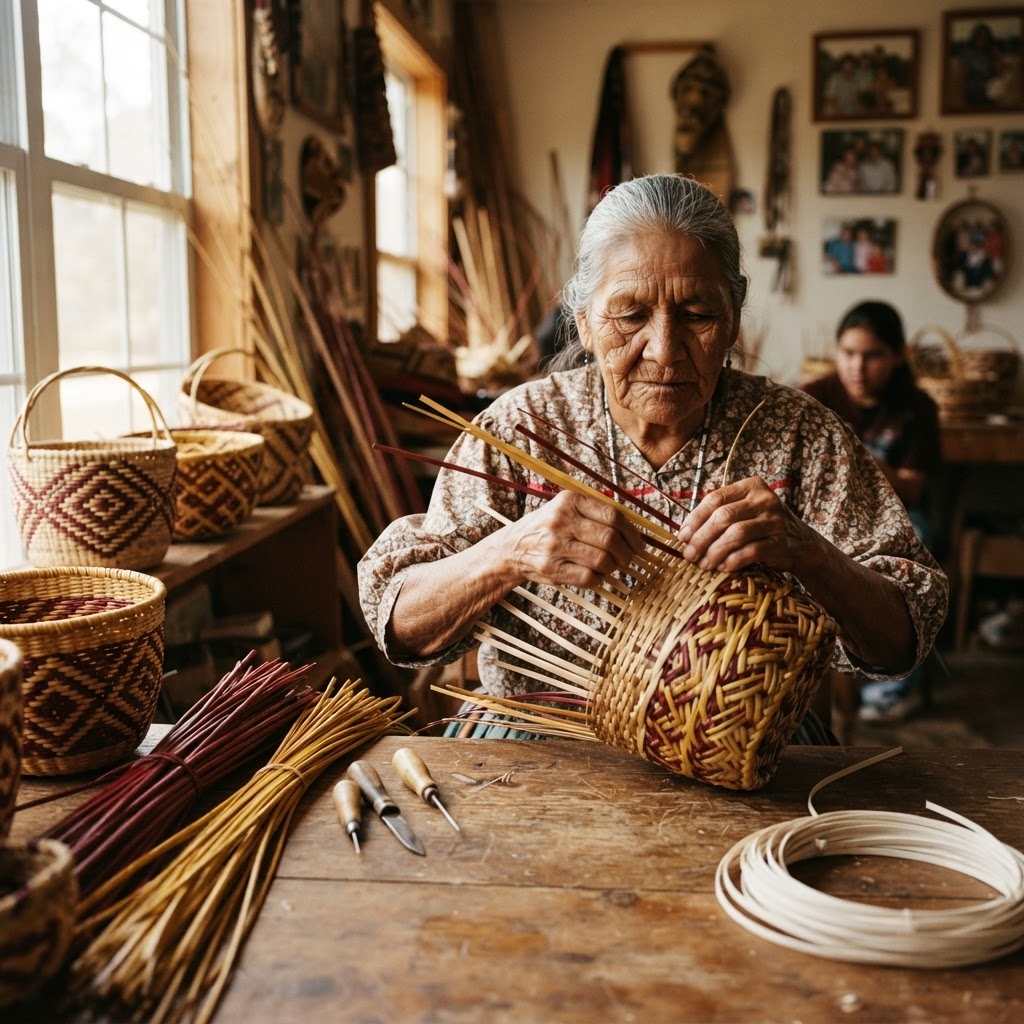
The Art of Defiance: Cherokee Basket Weaving and the Threads of Survival
Let’s set the record straight: Cherokee basket weaving isn’t a hobby you pick up at a weekend craft retreat. It is a sophisticated, ancient system of mathematics, botany, and engineering that has survived forced removal, cultural erasure, and environmental collapse. When you hold a Cherokee basket, you aren’t just holding a container; you are holding a piece of sovereign history that refuses to be forgotten. At Osiyo.net, we believe in telling the story of the Cherokee people with the grit and accuracy it deserves. This isn’t just about pretty patterns; it’s about survival.
Key Takeaways
- Cherokee basketry predates European contact by thousands of years, originally utilizing rivercane.
- The “Double Weave” is a uniquely complex Cherokee technique that produces a waterproof, two-layered basket.
- The three federally recognized Cherokee tribes—the Cherokee Nation, the Eastern Band of Cherokee Indians (EBCI), and the United Keetoowah Band (UKB)—maintain distinct but overlapping weaving traditions.
- Environmental preservation of rivercane is currently a critical issue for tribal sovereignty and cultural continuity.
More Than a Container: The Cultural Weight of the Basket
To understand the basket, you have to understand the land. Before the forced removal known as the Trail of Tears, the Cherokee people occupied the lush, river-dense regions of the Southeastern United States. Basketry wasn’t an “art form” in the Western sense; it was essential infrastructure. Baskets were used for catching fish, sifting cornmeal, storing seeds, and carrying heavy loads. But they were also deeply spiritual. The patterns woven into the walls of these vessels often told stories of the cosmos, the natural world, and the matrilineal clans that define Cherokee identity.
“Our baskets are the physical manifestation of our endurance. Every strip of cane or oak is a connection to an ancestor who refused to let the fire go out.”
When the majority of the Cherokee people were forced into Indian Territory (modern-day Oklahoma), they didn’t just lose their homes; they lost their primary material: Arundinaria gigantea, or rivercane. The story of Cherokee basketry in the 19th and 20th centuries is one of radical adaptation. Those who remained in the East (the ancestors of the EBCI) continued their relationship with rivercane, while those in the West (the Cherokee Nation and UKB) had to innovate with what the new land provided.
Materials of the Land: Rivercane, Oak, and Blood
The materials used in Cherokee basketry are dictated by the geography of the three Tribal Nations. While the techniques remain similar, the raw elements tell you exactly where a basket comes from.
The Master of the Swamp: Rivercane
Rivercane is the traditional, pre-contact material of the Cherokee. It is a native bamboo that once grew in massive “canebrakes” across the Southeast. Preparing rivercane is a brutal, labor-intensive process. Each stalk must be split into four pieces, the inner pith scraped away, and the outer skin—which is naturally glossy and silica-rich—polished to a shine. Because rivercane is so tough, it is incredibly durable and can be woven so tightly it becomes water-resistant. Today, the Eastern Band of Cherokee Indians are the primary keepers of the rivercane tradition, though artisans in the Cherokee Nation are working hard to restore canebrakes in Oklahoma.
Adaptation in the Woods: White Oak
When the Cherokee arrived in Oklahoma, rivercane was scarce. They turned to the White Oak tree. This wasn’t just a backup plan; it was a feat of engineering. To make a basket from a tree, you have to find a straight-growing oak with no lower branches, fell it, and then split the green wood into thin, flexible “splints.” White oak baskets are rugged and functional, often featuring the iconic “rib” construction or the “stave and weaver” method. You can learn more about these adaptations in our cultural stories section.
The Colors of the Earth: Natural Dyes
A true Cherokee basket never uses synthetic store-bought dyes. The colors come from the earth itself. The two most iconic pigments are:
- Black Walnut: The hulls of the walnut produce a deep, rich chocolate brown or black.
- Bloodroot: The rhizome of this woodland plant produces a vibrant, earthy orange or red.
- Butternut: Often used for lighter tans and browns.
The process of dying is a chemistry lesson in itself. The weavers must boil the materials with the dyes for hours, sometimes using “mordants” (like wood ash) to fix the color so it won’t fade over centuries. This isn’t just aesthetic; it’s botanical sovereignty.
The Mathematical Genius of the Double Weave
If you want to see a basket weaver flex their intellectual muscles, look at a double-weave basket. This is a technique almost unique to the Cherokee. Essentially, the weaver starts at the bottom, weaves up the sides to the rim, and then—without cutting the material—folds the splints over and weaves a second basket down the outside, ending back at the bottom. The result is a basket with two distinct walls, often featuring different patterns on the inside and outside. In the early 20th century, this technique was nearly lost, but it was revitalized by visionary weavers like Lottie Queen Stamper of the EBCI. It remains one of the most difficult feats in the world of fiber arts.
Comparing the Traditions: A Tribal Breakdown
While we are one people, the history of the three federally recognized tribes has created unique nuances in their basketry traditions. It’s important to distinguish these when you’re looking at educational resources or visiting tribal lands.
| Feature | Eastern Band of Cherokee Indians (NC) | Cherokee Nation (OK) | United Keetoowah Band (OK) |
|---|---|---|---|
| Primary Material | Rivercane, Honeysuckle | White Oak, Buckbrush | White Oak, Buckbrush, Rivercane |
| Key Styles | Rivercane Double Weave | Oklahoma Rib Baskets | Traditional Keetoowah Patterns |
| Famous Dyes | Bloodroot, Butternut | Black Walnut, Pecan hulls | Walnut, Wild Plum |
| Focus | Preservation of SE traditions | Innovation with Western materials | Keetoowah-specific traditionalism |
For more details on the differences between the tribal governments, see our page on The Three Cherokee Nations. Osiyo.net is not a tribal government site, so always check with official tribal portals for specific artisan registries.
The Battle for the Cane: Environmental Sovereignty
You can’t have Cherokee baskets without the plants. Today, the greatest threat to this tradition isn’t a lack of interest—it’s the loss of habitat. Invasive species, urban sprawl, and agricultural runoff have decimated the native canebrakes. This is where culture meets politics. The Bureau of Indian Affairs and various tribal environmental departments are now engaged in massive rivercane restoration projects. This is a matter of sovereignty; if the Cherokee cannot access their traditional materials on their own land, their culture is under siege. Weavers are not just artists; they are environmental stewards and land defenders.
Preserving the Craft: How to Support Indigenous Artists
If you are looking to purchase a Cherokee basket, do it right. The Indian Arts and Crafts Act of 1990 makes it illegal to market art as “Native American” or “Indian” if the artist is not a member of a federally or state-recognized tribe. Don’t buy “Cherokee-style” baskets from big-box retailers. Seek out certified tribal citizens. This supports the economic sovereignty of the tribal communities and ensures the tradition continues. If you’re interested in the history of tribal identification, check out our guide on the CDIB and tribal membership.
FAQ
What is the most famous Cherokee basket pattern?
The “Noonday Sun,” “Chain,” and “Chief’s Daughter” are some of the most recognizable patterns. These patterns are achieved through the “twill” weaving technique, where the weaver skips over a specific number of horizontal splints to create geometric designs.
Why are Cherokee baskets so expensive?
You aren’t just paying for a basket. You are paying for the days spent harvesting wood in the heat, the weeks spent processing the materials, the expertise of natural dye chemistry, and the hours of intricate weaving. A single rivercane basket can take months to complete from harvest to finish.
Can I learn to weave Cherokee baskets if I am not Cherokee?
While many tribal members teach workshops, it is important to approach the craft with respect. Many patterns and techniques are considered culturally sensitive or intellectual property of the Tribal Nations. Always support tribal-led education programs rather than unsanctioned “hobbyist” groups.
Next Steps
- Explore the official websites of the Cherokee Nation, EBCI, and United Keetoowah Band to find registered artists.
- Visit the Museum of the Cherokee Indian in Cherokee, NC, or the Cherokee National Museum in Tahlequah, OK, to see historic baskets in person. Check out our travel guide for more info.
- Learn more about the history of the Cherokee people and our journey to the present day in our stories section.
- If you are looking for information on your own heritage, start with our Getting Started guide.
Last reviewed: June 2026
Osiyo.net is an independently operated information platform. Always verify enrollment information directly with the specific Tribal Nation.