

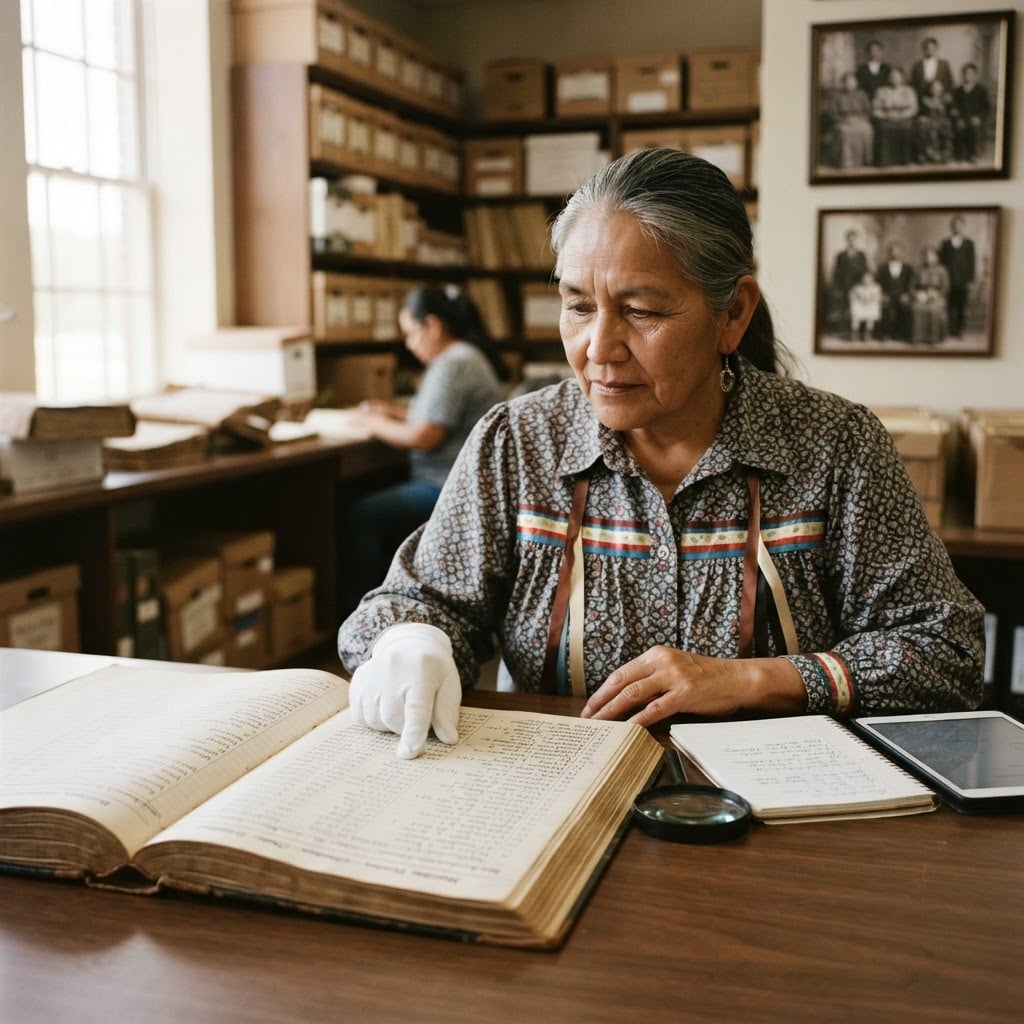
Cherokee Nation Marriage Records: Researching Family History in Indian Territory
Searching for marriage records in the old Indian Territory isn’t like searching for a marriage license in modern-day Chicago or Los Angeles. It’s a dive into a complex, often messy collision of tribal sovereignty, federal overreach, and the shifting borders of what would eventually become Oklahoma. If you are hunting for ancestors who tied the knot within the boundaries of the Cherokee Nation before 1907, you aren’t just looking for a date and a name; you’re looking for evidence of a legal system that the U.S. government tried very hard to erase.
At Osiyo.net, we believe in telling the truth about these records. Most genealogy sites will give you a sanitized version of history. We’re here to give you the reality: the records are fragmented because the history was fragmented. Whether you are tracing lineage for a family story or trying to understand the legal status of an ancestor during the allotment era, understanding the ‘who, where, and why’ of Cherokee marriage records is essential. Note: Osiyo.net is an independently operated information platform. We are not an official tribal government site.
The Tangled Web of Tribal and Federal Paperwork
Before the late 1800s, the Cherokee Nation operated as a fully autonomous legal entity with its own courts, laws, and record-keeping. When two Cherokee citizens married, they did so under the jurisdiction of the Cherokee Nation. However, as the 19th century progressed, the United States began encroaching on that sovereignty with increasing aggression. This created a dual system of record-keeping that can be a nightmare for modern researchers if they don’t know the timeline.
“To understand the record, you must understand the law of the time. In Indian Territory, the law changed depending on who you were and exactly which year you said ‘I do.'”
The biggest hurdle for researchers is the transition from tribal courts to federal courts. By the time the Final Rolls (Dawes Rolls) were being compiled, the U.S. government had largely stripped the Cherokee Nation of its judicial power. This means your ancestor’s marriage record might be in a tribal archive, a federal archive, or a dusty county basement, depending on the date.
Understanding Jurisdiction: Who Held the Pen?
To find the record, you have to know who had the authority to issue it. The history of marriage in the Cherokee Nation is divided into three distinct eras. Each era has its own primary source for documentation.
Pre-1898: The Cherokee Court System
Until the late 1890s, the Cherokee Nation maintained its own court system. Marriage licenses were issued by district clerks within the Cherokee Nation’s various districts (such as Tahlequah, Cooweescoowee, or Delaware). These records were maintained by the Tribe. If your ancestors married during this time, they were following Cherokee law. If one party was non-Cherokee, they often had to obtain a permit or pay a fee to marry a Cherokee citizen, a process that generated even more paperwork—which is a goldmine for genealogists today.
1898–1907: The Curtis Act and Federal Intrusion
The year 1898 was a turning point. The Curtis Act effectively abolished tribal courts and mandated that all legal matters in Indian Territory be handled by U.S. Federal Courts. This was a direct assault on tribal sovereignty. From 1898 until Oklahoma statehood in 1907, marriages were recorded by the U.S. Clerk of the Court in various judicial districts of Indian Territory. If your ancestors married in 1902, don’t look for a tribal record; look for a federal record held in what would become the county seat.
1907 to Present: Oklahoma Statehood
Once Oklahoma became the 46th state in 1907, the tribal and federal court records for marriages were largely absorbed into the state’s county court system. From this point forward, Cherokee citizens were required to follow Oklahoma state law for marriage licenses, just like any other resident. However, many older tribal records were transferred to the Oklahoma Historical Society or the National Archives during this transition.
Where to Find the Records Today
Now that you know the timeline, where do you actually look? There is no single “Cherokee Marriage Database” that covers everything. You have to hunt through several repositories.
- The National Archives (NARA): Specifically the records of the Bureau of Indian Affairs (BIA). NARA holds many of the original Cherokee Nation records that were seized or turned over during the allotment period. You can search these through the National Archives website or at the regional branch in Fort Worth, Texas.
- Oklahoma Historical Society (OHS): The OHS holds a massive collection of Indian Territory records, including many marriage books from the Cherokee districts. Their online catalog is an excellent starting point for any genealogical journey.
- County Clerk Offices: For marriages occurring between 1898 and 1907, the records are often still held at the county courthouse in the county that succeeded the old federal judicial district. For example, records from the Tahlequah District might be found in Cherokee County, OK.
- The Dawes Rolls: While not a marriage registry, the Dawes Rolls application packets (the “Testimony”) often include marriage certificates or affidavits as proof of relationship. If you are looking for a link to an ancestor, these packets are essential.
Comparing the Three Federally Recognized Cherokee Tribes
It is a common misconception that all Cherokee people fall under one administrative umbrella. When researching marriage records, you must distinguish between the three federally recognized tribes, as their records are kept in different places and reflect different histories.
| Tribe | Primary Location | Marriage Record Context |
|---|---|---|
| Cherokee Nation (CN) | Tahlequah, OK | Focuses on Indian Territory records and the Dawes Rolls. |
| United Keetoowah Band (UKB) | Tahlequah, OK | Often shares historical record sources with CN but maintains its own tribal identity. |
| Eastern Band of Cherokee Indians (EBCI) | Cherokee, NC | Records are primarily in North Carolina (Qualla Boundary); not tied to IT marriage records. |
If your ancestor stayed in North Carolina after the Trail of Tears, you won’t find their marriage record in Oklahoma. You’ll be looking at records held by the EBCI or the North Carolina State Archives. Conversely, CN and UKB ancestors will almost exclusively be documented in Oklahoma-based or federal archives.
Common Pitfalls in Cherokee Marriage Research
Don’t expect the records to be perfect. The U.S. government’s attempt to document Cherokee families was often riddled with errors, bias, and a lack of understanding of Cherokee social structures.
1. Misspelled Names
Federal clerks often wrote names phonetically. A Cherokee name might be spelled three different ways in three different documents. Always use wildcard searches and look for variations of surnames.
2. The “Intermarried White” (IW) Category
The Dawes Commission created a specific category for white individuals who married into the tribe. These records are incredibly detailed because the government was skeptical of these unions. If your ancestor is listed as “IW,” you are likely to find a copy of their marriage license in their enrollment packet, as they had to prove the legality of the marriage under Cherokee law to receive an allotment.
3. Common Law Unions
Cherokee custom often recognized unions that didn’t involve a formal license from a clerk. While the U.S. government tried to force these couples to “legalize” their marriages for the sake of the Dawes Rolls, some unions went unrecorded by the state or feds, existing only in tribal census records or oral histories.
4. Traditional vs. Christian Ceremonies
By the late 1800s, many Cherokees were practicing various forms of faith, leading to a mix of traditional and church-recorded marriages. If you can’t find a civil record, check local church records in the Cherokee Nation districts.
Key Takeaways
- Timeline Matters: Pre-1898 records are tribal; 1898-1907 are federal; post-1907 are state.
- Geography is Key: Know the specific district of the Cherokee Nation where your ancestors lived.
- Search the Packets: The Dawes Rolls application folders are often more useful than the marriage books themselves.
- Sovereignty is the Context: These records exist because the U.S. was trying to manage and eventually dismantle tribal land ownership.
- Official Sources: Always cross-reference with cherokee.org for modern citizenship questions.
Frequently Asked Questions
Where can I find Cherokee marriage records online?
Many are digitized on platforms like FamilySearch or Ancestry, but the most accurate historical sources are the Oklahoma Historical Society and the National Archives (NARA). Always check the “Indian Territory, Marriage Records” collections.
What if my ancestors married before the Trail of Tears?
Records from the early 1800s in the original homelands (Georgia, Tennessee, etc.) are much harder to find. You may need to look at missionary records or early tribal census records rather than formal marriage licenses.
Does finding a marriage record prove tribal enrollment?
No. A marriage record proves a legal union occurred. For information on Cherokee citizenship, you must consult the specific requirements of the three federally recognized tribes. A marriage record is just one piece of the genealogical puzzle.
What is a “permit” marriage?
In the Cherokee Nation, a non-citizen (usually a white man) had to obtain a permit to live and work in the Nation and a specific license to marry a Cherokee citizen. These permits are often found in the Cherokee National Records at the OHS.
Next Steps for Your Research
Ready to dig deeper? Start by identifying the approximate year of the marriage. Once you have a date, follow these steps:
- Search the Dawes Rolls for both spouses to see if a marriage is mentioned in their testimony.
- Check the Oklahoma Historical Society online catalog for the specific Cherokee district.
- Contact the National Archives at Fort Worth for BIA records related to the Cherokee Agency.
- Explore our guide on Cherokee history and education to understand the world your ancestors lived in.
Researching your roots in the Cherokee Nation is an act of reclaiming history. It’s about more than just names on a page; it’s about honoring the resilience of families who navigated a changing legal landscape while maintaining their identity as Cherokee people.
Last reviewed: June 2026
Osiyo.net is an independently operated information platform. Always verify enrollment information directly with the specific Tribal Nation.