

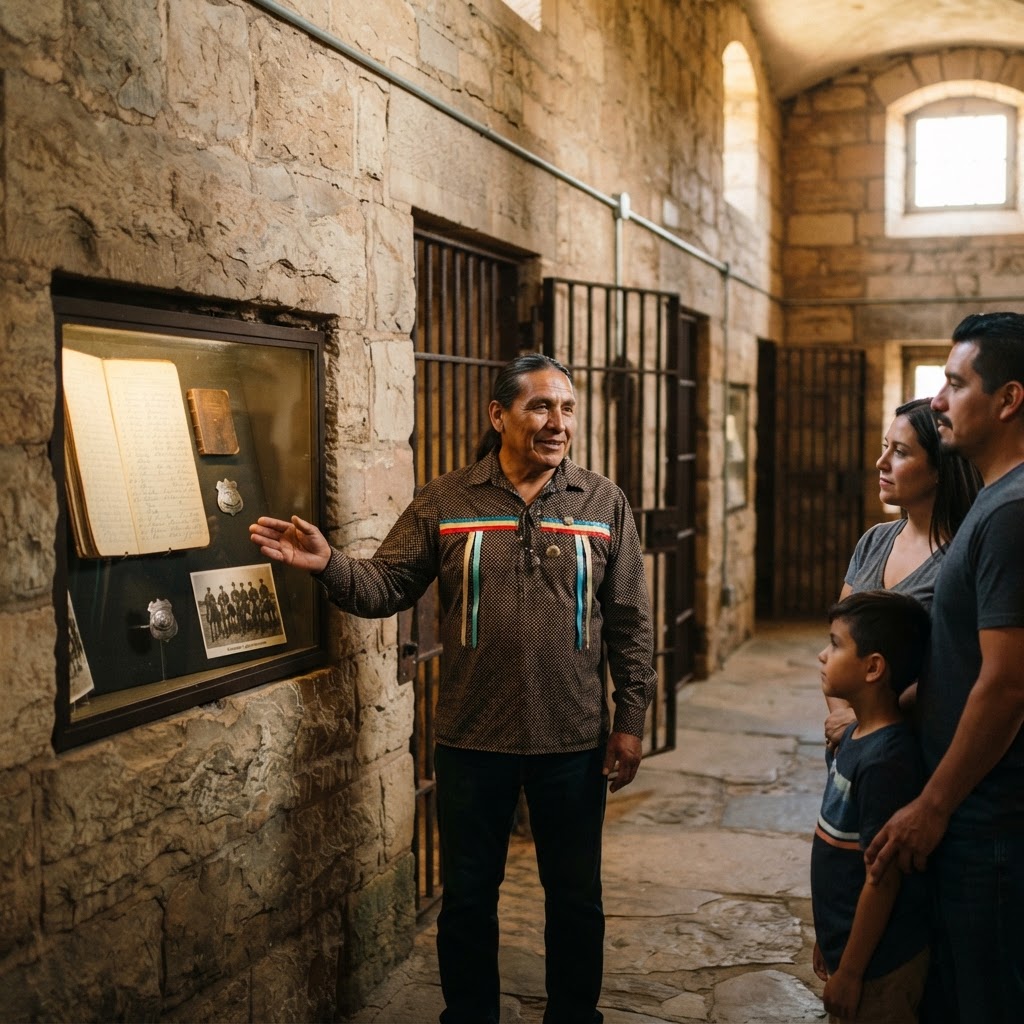
Cherokee National Prison Museum: Justice, Sovereignty, and the Sandstone Sentinel
Key Takeaways
- Built in 1875, the Cherokee National Prison is the oldest standing government building in the Cherokee Nation’s capital, Tahlequah.
- It served as a physical manifestation of Cherokee sovereignty, designed to prove the Nation could self-govern according to Western legal standards.
- The museum explores the shift from traditional restorative justice to a punitive system modeled after the United States.
- Visitors can see the only gallows ever used for a legal execution in the Cherokee Nation and the infamous “Black Hole” solitary cell.
- Osiyo.net is an independent platform; always consult official tribal resources for legal or enrollment matters.
If you walk down the streets of Tahlequah, Oklahoma, you will eventually find yourself staring at a massive, two-story sandstone structure that looks like it belongs in a gothic novel rather than a bustling modern town. This is the Cherokee National Prison Museum. It isn’t just a place where people were locked up; it is a monument to a Nation’s survival, a testament to its legal sophistication, and a grim reminder of the pressures of colonization. For those interested in the real history of Indian Territory—not the Hollywood version where every indigenous person is either a “noble savage” or a “lawless renegade”—this museum is essential viewing.
A Sovereign Statement in Stone
In the mid-19th century, the Cherokee Nation was under a microscope. After the devastation of the Trail of Tears and the internal fracturing of the American Civil War, the Nation was rebuilding its capital. The U.S. government was looking for any excuse to dissolve tribal governments and take control of their lands. One of their primary arguments was that Indian Territory was “lawless.”
The Cherokee response? They built a prison. Not just a wooden shack, but a $6,000 sandstone fortress designed by architects from St. Louis. Completed in 1875, the prison sent a clear message to Washington: We have laws, we have a judicial system, and we have the infrastructure to enforce it. This was sovereignty in stone. By visiting the travel destinations of the Cherokee Nation, you see how these structures were tactical defenses against federal encroachment.
The Lighthorse Police
Before the stone prison, the Cherokee Nation relied on the Lighthorse Police. These were elite, mounted officers tasked with maintaining order across vast territories. Justice was often swift and decentralized. However, as the influx of non-citizens into Indian Territory grew, the legal landscape became a nightmare of jurisdictional overlap between the Cherokee courts and the federal court at Fort Smith, presided over by the infamous “Hanging Judge” Isaac Parker.
Life Inside: From Reform to the Black Hole
The Cherokee National Prison was designed to be escape-proof. Its walls were two feet thick, and it housed some of the most notorious figures in the territory, including members of the Starr gang. But the museum doesn’t just focus on the “outlaw” glamour. It dives deep into the lived reality of those held within.
The Architecture of Incarceration
The building originally had cells on both floors. The lower level was often used for more dangerous criminals, while the upper level housed those awaiting trial or serving shorter sentences. There was a kitchen, a mess hall, and a small yard. The prisoners weren’t just sitting idle; many were put to work on public works projects in Tahlequah, which was another way the Nation demonstrated its “civilized” status to the watching federal agents.
“The prison was a necessity born of transition. We were moving from a system of clan-based restitution to a Western model of punitive justice, all while fighting to keep the federal government out of our business.” – Historical Perspective
The Black Hole
One of the most sobering exhibits is the “Black Hole.” This was a small, pitch-black solitary confinement cell used for the most disruptive prisoners. Standing in the reconstructed space, you get a visceral sense of the isolation and psychological toll of 19th-century incarceration. It serves as a stark contrast to traditional Cherokee values which, historically, prioritized making the victim whole over simply punishing the perpetrator.
The Gallows: A Single, Somber Event
Outside the main building stands a reconstruction of the gallows. Despite the violent reputation of Indian Territory, the Cherokee Nation only carried out one legal execution at this site. In 1892, Edward Reed was hanged for the murder of Thomas McLain. The museum handles this history with a heavy sense of gravity, refusing to sensationalize the death. Instead, it places the event within the context of the Nation’s struggle to maintain its own judicial authority before the Curtis Act of 1898 effectively stripped the tribal courts of their power.
The Three Tribes and Modern Justice
It is important to distinguish the different contexts of the three federally recognized Cherokee tribes when discussing historical justice. The Cherokee Nation (CN) and the United Keetoowah Band of Cherokee Indians (UKB) are both headquartered in Oklahoma, and their ancestors lived through the era of the Tahlequah prison. The Eastern Band of Cherokee Indians (EBCI), based in North Carolina, maintained their own separate legal history and sovereign structures on their ancestral lands. You can learn more about these distinctions in our section on the three tribes.
Today, the Cherokee Nation has a robust, modern justice system, including its own Supreme Court and a sophisticated leadership structure. The prison museum serves as a bridge between the historical Lighthorse and the modern Marshall Service.
Comparison: Tribal Justice vs. Federal Incursion (1875-1900)
| Feature | Cherokee National Justice | U.S. Federal (Fort Smith) |
|---|---|---|
| Jurisdiction | Cherokee Citizens within the Nation | Non-citizens and “Major Crimes” |
| Primary Goal | Sovereign autonomy and public order | Assimilation and land opening |
| Key Enforcement | Lighthorse Police / Sheriff | U.S. Marshals |
| Physical Site | Tahlequah Prison | Fort Smith Federal Court |
The Museum Experience Today
When you visit the Cherokee National Prison Museum, you aren’t just looking at old leg irons. The museum features interactive displays that allow you to participate in a “CSI: Cherokee Nation” style investigation, using historical documents to solve crimes. It’s an engaging way to understand how evidence was gathered and how law worked in a territory where the boundaries between nations were often contested.
Interpretive Exhibits
- The Lighthorse Exhibit: Showcasing the uniforms, weaponry, and stories of the men who rode for the Nation.
- The Evolution of Law: A timeline showing the development of the Cherokee Constitution and its subsequent amendments.
- The Prison Yard: An outdoor space featuring the gallows and interpretive signage regarding the site’s later use as a county jail.
The Hard Truth About History
Let’s be edgy for a second: the Cherokee National Prison exists because the U.S. government forced the Cherokee people into a corner. To be “civilized” in the eyes of 19th-century white America meant adopting their forms of punishment. The prison is as much a symbol of colonial pressure as it is of tribal resilience. While the building is a masterpiece of stonework, it represents a departure from ancient Cherokee ways of handling social harmony. Exploring these nuances is part of the stories we tell here at Osiyo.net.
Next Steps to Explore Cherokee Heritage
- Visit the Site: The museum is located at 125 E. Choctaw St, Tahlequah, OK. Check cherokee.org for current hours.
- Research Your Roots: If you are looking for ancestors who might have been in Indian Territory during this era, start with our Final Rolls search guide.
- Understand Citizenship: Learn about the requirements for Cherokee citizenship today and how it differs from historical enrollment.
- Explore the Capital: Visit the about section to see other historical sites in the Tahlequah area.
Frequently Asked Questions
Was the prison used for non-Indians?
Generally, no. Under the complex jurisdictional rules of the time, the Cherokee Nation only had the authority to try and imprison its own citizens. Non-citizens who committed crimes in the Nation were usually handed over to the U.S. Federal Court in Fort Smith, Arkansas.
Is the museum haunted?
While many locals have stories about the “spirits” of the sandstone walls, the museum focuses on historical accuracy and education. However, the atmosphere of the “Black Hole” is certainly enough to give anyone chills.
How long does a tour take?
Most visitors spend about 60 to 90 minutes exploring the indoor exhibits and the outdoor prison yard. It is a self-guided experience with plenty of reading material and interactive elements.
Is it family-friendly?
Yes, though parents should be prepared to discuss the nature of prisons and the history of the gallows with their children. The “CSI” interactive elements are particularly popular with older children and teens.
Conclusion
The Cherokee National Prison Museum is a vital piece of the American story. It challenges the myths of the “Wild West” and places indigenous sovereignty at the center of the narrative. It reminds us that the Cherokee Nation didn’t just survive the 19th century—it governed through it. Whether you are a citizen looking for your history or a visitor seeking the truth, the sandstone sentinel of Tahlequah has much to tell you.
Last reviewed: June 2026
Osiyo.net is an independently operated information platform. Always verify enrollment information directly with the specific Tribal Nation.